
In the dimly lit basement of a dusty university library, Dr. Emily Turner sat hunched over a computer screen, her fingers tapping away at the keyboard. The screen displayed the genetic data of countless individuals from around the world, all connected by a tiny but significant thread — the maternal haplogroup J1c2c. Emily had spent years of her life tracing this lineage, and tonight, she felt like she was closing in on a long-lost secret.
The maternal haplogroup J1c2c was a genetic marker that could be traced back to a woman who lived approximately 4,500 years ago. She had been part of a small group of humans who had migrated to Europe from the Middle East as the Ice Age receded between 14,000 and 11,000 years ago. Today, J1c2c is found almost exclusively within Europe, but there were puzzling traces in the Middle East. Researchers speculated that these traces were due to eastward migrations of people much later in human history, but Emily had a different theory.
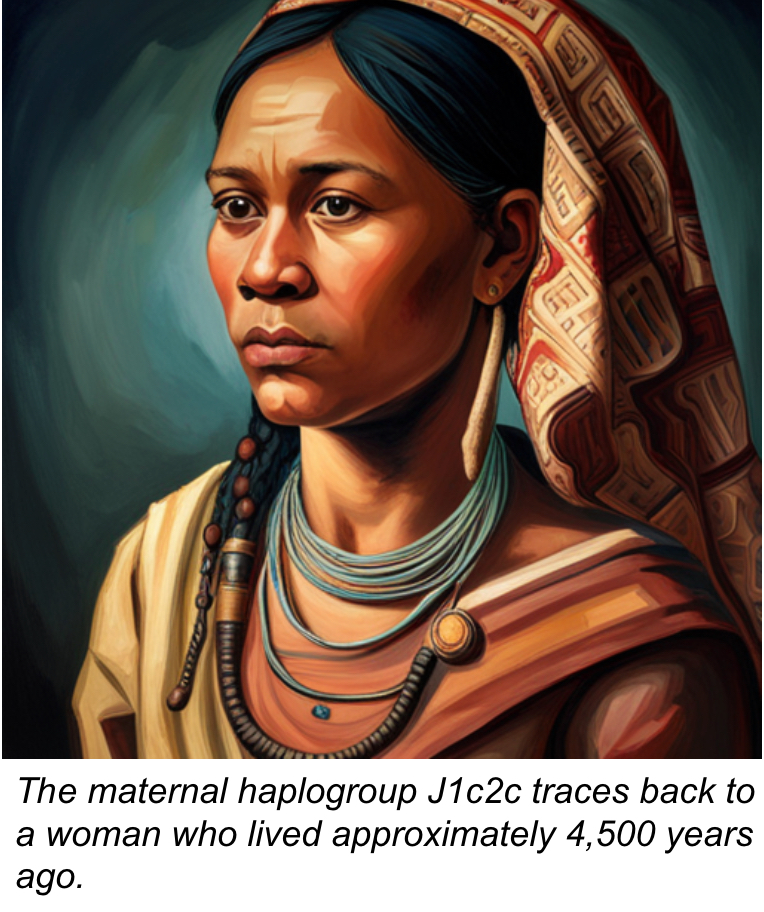
As Emily delved deeper into the genetic data, her mind raced with possibilities. What if the maternal haplogroup J1c2c had not just randomly appeared in the Middle East but had originated there? What if there was a hidden story of migration and connection that had yet to be uncovered?
Late one evening, as the rest of the world slept, Emily stumbled upon a set of genetic markers that sent a shiver down her spine. They were a match, a perfect match, to the J1c2c lineage. But they were not from Europe or the Middle East; they were from a remote village nestled deep in the rugged mountains of the Caucasus.
Emily wasted no time. She packed her bags and embarked on a journey to the Caucasus, determined to uncover the truth. The journey took her through winding mountain roads, past quaint villages, and finally to the village that had appeared on her screen. The locals were warm and welcoming, and they had stories to tell.
The village elder, an elderly woman named Marika, sat with Emily by the fire, sipping tea as they spoke. Marika told Emily about the ancient legends of their people, tales of migrations and distant ancestors who had come from a land far to the west. Emily’s heart raced as the puzzle pieces began to fall into place.
Over the following weeks, Emily worked closely with the people of the village, collecting DNA samples and piecing together their family histories. It became evident that the J1c2c lineage had indeed originated here, in the Caucasus. The story was a journey that had taken them from these mountains to Europe and back again over thousands of years, a story of resilience and survival in the face of changing climates and landscapes.
As Emily’s research gained recognition, scientists worldwide flocked to the Caucasus to study this remarkable discovery. It was a breakthrough that reshaped our understanding of human migration and the interconnectedness of all people on Earth.
Ultimately, the story of the maternal haplogroup J1c2c was not just about genetics but the enduring spirit of humanity. It reminded us that we are all linked, no matter how distant our ancestors may seem, and that our shared history is a tapestry woven from threads stretching across continents and millennia. Emily had unlocked a hidden chapter in that tapestry that would forever change how we saw ourselves and our place in the world.

 The Diederich Journal