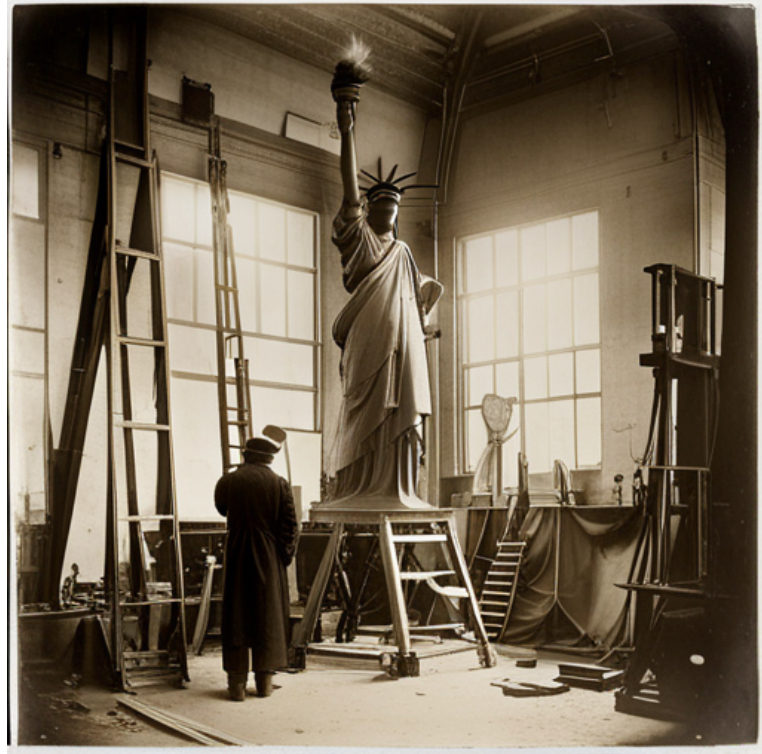
Paris – March 14, 1880: The workshop of the renowned French sculptor Frédéric Auguste Bartholdi was alive with the rhythmic clinks of hammers and the passionate whispers of artists. At the center of this creative storm stood a remarkable prototype, a smaller version of the colossal masterpiece that would soon become an enduring symbol of freedom: the Statue of Liberty.
Frédéric Auguste Bartholdi had dedicated his life to the art of sculpture, and his vision extended far beyond the confines of France. The idea for the statue had been born during his travels to the United States in the early 1870s, where he had been struck by the spirit of liberty and democracy that the American people held dear. Inspired by the alliance between France and the United States during the American Revolution, Bartholdi embarked on a mission to create a monumental gift to symbolize the enduring friendship between the two nations.
Upon his return to France, Bartholdi joined forces with his close friend Édouard René de Laboulaye, a French political thinker and abolitionist. Together, they founded the Franco-American Union, a remarkable organization that sought to raise funds for the ambitious project. The people of France rallied behind their cause, contributing some 600,000 francs to turn their dream into a reality.
Work on the statue, officially titled “Liberty Enlightening the World,” commenced in 1875. Bartholdi and his dedicated artisans and craftsmen meticulously crafted the statue from hammered copper sheets that were skillfully shaped over a steel framework. The project’s engineering genius was Gustave Eiffel, who had joined the venture in 1879. His innovative framework would provide the necessary support for the colossal statue, ensuring its strength and stability.
As the years passed, the various parts of the statue began to take shape. In 1876, the completed torch and left forearm were displayed in Philadelphia and New York City. These public exhibitions not only mesmerized onlookers but also raised much-needed funds for the construction of the statue’s enormous pedestal.
When the statue was fully assembled in France, it stood just over 151 feet tall and weighed a staggering 225 tons. It was a testament to French and American artisans’ craftsmanship, dedication, and collaborative spirit.
In 1884, the completed statue was unveiled in a grand ceremony in Paris, presided over by Ambassador Levi Morton. The people of France, along with those who had supported the Franco-American Union, watched with pride as the colossal symbol of liberty was presented to the world. However, this was not the end of the journey for the Statue of Liberty.
The statue was carefully disassembled and packed into crates for a transatlantic journey to its new home. In 1885, these crates arrived in the bustling harbor of New York City, where Lady Liberty would find her permanent residence on Bedloe’s Island. Over the course of several months, she was painstakingly reconstructed on her pedestal, rising triumphantly to her full height.
On October 28, 1886, in the presence of President Grover Cleveland and a throng of excited onlookers, the Statue of Liberty was officially dedicated. With her torch held high, she welcomed immigrants arriving in the “Land of the Free,” a symbol of hope and liberty that would forever shine brightly in the heart of America’s most fantastic city.
The Statue of Liberty had made an epic journey from the drawing board of Frédéric Auguste Bartholdi’s workshop in Paris to the shores of New York Harbor. It was a testament to the enduring friendship between France and the United States, a symbol of liberty that would inspire generations and a beacon of hope for all who sought a better life on American soil.

 The Diederich Journal