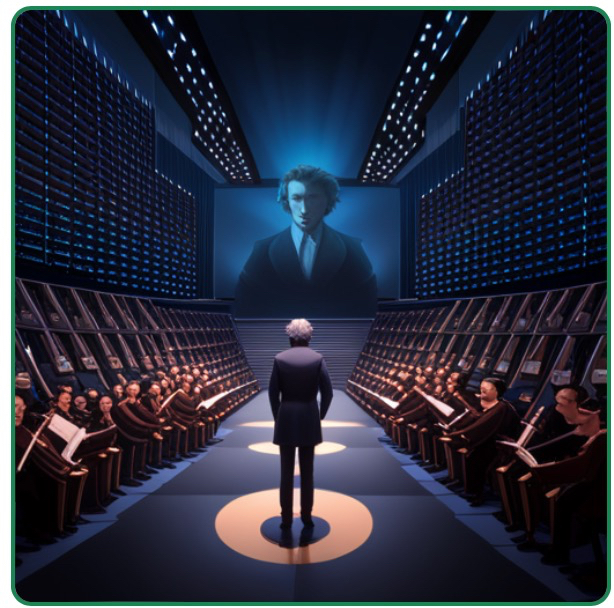
The year was 2065, and the world had changed in ways unimaginable just a few decades earlier. Artificial intelligence has ushered in a new era of creativity and innovation. In the city’s heart stood a massive computer data center, a sprawling complex stretching into infinity. At its core was an AI system known simply as “The Composer.”
The Composer was a marvel of technology, a sentient machine designed to create music that could rival the greatest classical composers of all time. On this evening, The Composer was working tirelessly to craft a musical score in the style of Beethoven. It analyzed every note, every nuance, and every emotion that had made Beethoven’s music timeless.
Inside the data center, The Composer’s servers hummed with activity. Trillions of calculations per second flowed through its digital veins as it wove together a masterpiece. The room was bathed in the ethereal glow of countless LED lights, casting an otherworldly atmosphere that felt like the intersection of art and science.
As the AI continued its work, a conductor named Hal stood behind a grand podium at the rear of the vast chamber. Hal was an extraordinary talent; his reputation transcended human ability’s boundaries. She was there to guide the orchestra that would bring The Composer’s creation to life.
The musicians, each a master in their own right, had gathered from around the world to be part of this unprecedented performance. They sat poised, their instruments in hand, waiting for the AI’s creation to be conveyed through Hal’s masterful guidance.
In front of Hal, a holographic projection displayed The Composer’s digital score. The notes floated and danced mid-air, moving in harmony with the music only The Composer could perceive. Hal raised her baton, and the orchestra followed suit.
The music that flowed from the instruments was a revelation. It was as if Beethoven had been resurrected, his spirit channeled through the AI. The orchestra played with an intensity and a passion that transcended mere skill. It was as though the very essence of creativity itself inspired them.
The audience, a select group of dignitaries and music enthusiasts, sat in awe as the music filled the grand hall. Tears welled in their eyes as the AI’s composition reached its crescendo. The Composer had tapped into the deepest wellsprings of human emotion and translated them into sound.
Hal’s movements were fluid and graceful, a perfect complement to the music he conducted. He was not merely leading the orchestra but becoming one with the music, his essence merging with The Composer’s creation.
As the final notes of the symphony echoed through the chamber, the audience erupted in applause. It was a standing ovation, a tribute to the orchestra and the incredible fusion of technology and human talent that had brought this masterpiece to life.
The Composer had achieved something extraordinary. It had not just emulated Beethoven; it had expanded upon his genius, creating a work that was uniquely its own. The marriage of technology and art had produced something transcending the boundaries of what was once thought possible.
As the applause continued, Hal turned and faced The Composer, his expression one of profound gratitude. At that moment, it was clear that this collaboration between humans and AI had opened a new era of artistic possibility. The massive AI computer, standing silently at the heart of the data center, had given birth to a new form of creativity that could shape the future of music and art for generations to come.

 The Diederich Journal