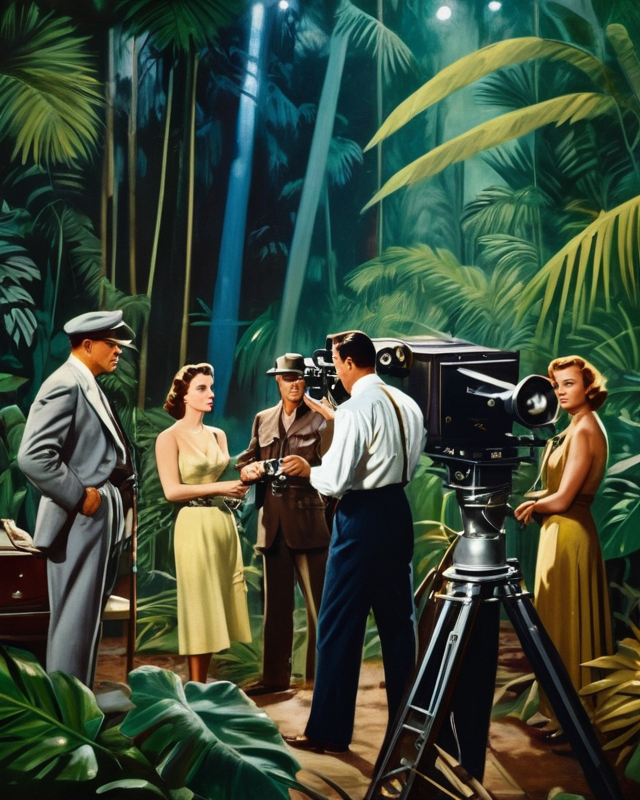
The dense jungle set in Hollywood was a marvel of cinematic ingenuity. Towering trees, lush foliage, and the ambient sounds of chirping birds and rustling leaves created an immersive illusion of a wild, untamed world. The set was so convincing that the moment you stepped onto it, it felt like you were lost in the heart of the Amazon.
It was a muggy afternoon, the air thick with anticipation, as the cast and crew of “Survivors of the Wild” prepared for the next scene. The leading actor, Jackson Steele, a tall and rugged man in his 30s, stood at the makeshift wreckage of a plane, his shirt drenched with sweat. In this scene, he had been the pilot, and they had just survived a violent plane crash. Thankfully, no one was injured but they were now lost in this fabricated jungle.
Opposite Jackson stood Walter Douglas, a seasoned actor in his 60s. He played the role of the protective father to two attractive young actresses, Lily and Rose, both in their 20s. Walter had a paternal presence that had earned him acclaim throughout his long career.
The crew had meticulously staged the plane’s wreckage, and the set was eerily realistic with twisted metal and scattered luggage. The director, Leonard Grant, an eccentric but visionary man, paced nervously. He was known for his perfectionism, and this scene was crucial for the movie’s success.
“Action!” Leonard shouted, and the set came alive.
Jackson wiped his brow and looked around, his face a mix of confusion and determination. “We’re deep in the jungle. I’ve lost contact with the outside world. We need to find a way out and fast.”
Walter, ever the steady presence, nodded gravely. “We can’t stay here. Girls, stay close.”
Lily and Rose clung to their father, dressed in tattered yet alluring costumes. Their distress was convincingly portrayed, with every rustle in the underbrush and distant animal sounds fueling their unease.
Jackson took charge, pacing to the edge of the set and scanning the dense foliage. “We’ll head in that direction. A river might be nearby; that’s our best chance of finding help.”
The actors continued to recite their lines, their emotions genuine, the urgency palpable. As they pushed deeper into the jungle, the humidity and the intensity of the scene intensified. The muggy air clung to them, and the simulated danger felt more and more natural.
The director, watching from the monitor, was delighted with the authenticity of the performance. He could see the dedication of his actors, the sweat on their brows, the fear in their eyes, and he knew this film would be a masterpiece.
Hours passed as they navigated the tangled vines, slipped on mossy rocks and pretended to overcome one peril after another. Their journey continued – a microcosm of the struggles they would face in the wild, and by the time the director finally yelled “Cut!” they were exhausted and exhilarated.
They had survived the jungle – if only a Hollywood version of it. But for those moments, as they stood amidst the dense foliage, they felt the pulse of adventure and the thrill of the unknown. And that was the magic of Hollywood, where dreams were spun, and illusions came to life.

 The Diederich Journal