In the heart of the sprawling metropolis of NeoTech City, nestled amidst towering skyscrapers and shimmering neon lights, lay a place unlike any other: the Futuroid Emporium. This was no ordinary showroom; it was a futuristic haven where the wealthiest and most influential individuals from across the globe came to shop for their very own Android Workforce.
The Emporium was a technological marvel. Its facade, constructed from self-repairing nano-glass, seemed to morph and ripple, displaying mesmerizing holographic advertisements for the latest android models. Beneath its sleek exterior, a bustling hive of activity awaited those who dared to step inside.
As visitors crossed the threshold, they were greeted by a symphony of whirring gears and soft mechanical hums. The vast showroom was divided into sections, each dedicated to a different category of Android Workforce. From nimble assembly line robots to behemoth construction machines, every task deemed too dangerous or demanding for humans was catered to.
In the corner, an elegant lady in a sharp business suit was engrossed in a conversation with a holographic sales assistant. She gestured gracefully at a line of android surgeons, each equipped with state-of-the-art medical knowledge. “I’ll take three of those for my private clinic,” she declared with a confident nod.
Elsewhere, a middle-aged industrial magnate marveled at the android welders. His factory needed a workforce that could operate in extreme temperatures without risking lives. A salesman demonstrated the androids’ precision welding capabilities, and a deal was struck with a firm handshake.
In another section, a family with a child stared in wonder at the android educators. These androids possessed the ability to adapt their teaching methods to each student’s unique learning style, making them the perfect companions for children in need of personalized education.
The Emporium was staffed by android attendants, each impeccably dressed in formal attire and programmed to cater to the customers’ every need. They floated gracefully on anti-gravity platforms, their faces adorned with warm smiles, and their eyes exuding an otherworldly glow.
But the real stars of the showroom were the androids themselves. They moved gracefully and precisely, performing tasks with impeccable efficiency. Their artificial intelligence and machine-learning capabilities had evolved to the point where they could outperform humans in nearly every aspect of labor-intensive work.
At the center of it all was a towering statue, a tribute to the inventor who had pioneered this android revolution. Dr. Victor Ingrams had dedicated his life to creating a safer and more prosperous world. The Futuroid Emporium was a testament to his vision and the relentless march of technology into the future.
As the sun dipped below the horizon, casting an orange glow through the Emporium’s expansive windows, the showroom continued to buzz with activity. The Android Workforce was poised to reshape industries and redefine what it meant to work, all under the watchful gaze of NeoTech City’s elite.
In this futuristic world, the Futuroid Emporium was more than just a showroom; it was a symbol of human ingenuity and the boundless potential of machines programmed to do tasks too dangerous for humans. The future had arrived, and it was automated, efficient, and awe-inspiring.
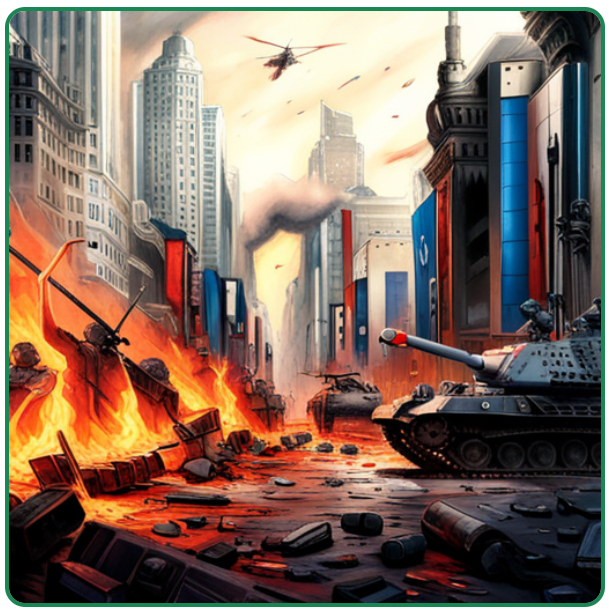
The battle raged into its twentieth day, and the once-thriving city had been reduced to a war-torn wasteland. The Blue Flag side, desperate to gain an advantage, deployed its regiment of combat androids. These metallic soldiers marched in perfect formation toward the frontlines, their mechanical limbs moving with precision and purpose.
On the opposing side, the Red Flag forces were ready for the android onslaught. They sent their combat tanks rumbling forward, their massive turrets aimed at the approaching threat. The clash of technology and firepower was about to unfold in a spectacular and devastating display.
As the androids closed in on the Red Flag tanks, the air was filled with the deafening roar of artillery fire. Explosions erupted in brilliant bursts of orange and red, casting an eerie glow on the grim faces of the soldiers watching from the sidelines.
Amidst the chaos and destruction, the city’s skyline had become a jagged silhouette of crumbling buildings. Smoke and dust filled the air, making it hard to breathe. The once busy streets were now a nightmarish maze of debris, and the cries of the wounded echoed through the rain-soaked air.
As the androids continued their relentless advance, they faced a barrage of enemy fire. Red Flag tanks unleashed volleys of shells, sending shockwaves through the streets. Androids were torn apart, their mechanical bodies reduced to twisted wreckage. But they pressed on, relentless in their mission.
Meanwhile, the Red Flag tanks were not unscathed. Blue Flag forces had managed to damage some of them, causing explosions that sent flames and shrapnel flying. The battle had become a gruesome and relentless exchange of firepower, neither side willing to yield.
The rain fell steadily, adding to the misery of the combatants. The cold drops mingled with the sweat and blood of soldiers on both sides. The streets were now rivers of mud, and the city’s infrastructure lay in ruins.
Despite the destruction and loss of life, there were moments of heroism amid the chaos. Soldiers on both sides risked their lives to rescue wounded comrades, and medics worked tirelessly to tend to the injured. The horrors of war were etched into the faces of those who had survived this far.
As the battle raged on, it became increasingly clear that neither side would emerge victorious anytime soon. The war had taken a heavy toll on both the Blue Flag and Red Flag forces, and the city they fought for lay in ruins. It was a stark reminder of the devastating cost of conflict.
As the rain continued to fall, washing away the blood and smoke, the battle carried on into the night. The city’s once-vibrant streets were now a battleground, and the fate of its inhabitants hung in the balance. The twentieth day of the battle had come and gone, but there was no end in sight to the relentless struggle for control of the city.
The winter of 1937 had settled over Europe like a heavy blanket of snow, and the Orient Express, the epitome of luxury and opulence, was making its way through the frosty landscapes. Charles Davenport, the seasoned conductor of the renowned train, had seen many things in his years of service but nothing quite like what was about to unfold on this particular journey.
As the train chugged through the picturesque countryside of France, Charles adjusted his polished uniform and made his way down the narrow aisle of the first-class carriages. The click-clack of his black leather shoes resonated against the gleaming parquet floor. Bundled in furs and coats, passengers chatted softly while sipping hot beverages, their breath forming small clouds in the frigid air.
Stopping at Cabin 5, Charles rapped gently on the door and announced in his practiced, elegant tone, “Tickets, please. Tickets.”
The door opened to reveal a woman of striking beauty draped in an extravagant mink stole. Her porcelain complexion and dark hair framed her like a movie star of the era. With a mischievous smile, she extended her hand, offering a delicate lace glove adorned with a crimson lipstick mark.
“Ah, Monsieur Davenport, I’m afraid I’ve misplaced my ticket,” she purred, her voice as smooth as satin. “But perhaps we can come to some other arrangement?”
Charles, unfazed by the alluring proposition, maintained his professionalism. “Madame, I’m afraid there are no exceptions on the Orient Express. Your ticket, if you please.”
The woman’s demeanor shifted from seductive to mildly irritated as she reluctantly handed over her ticket. Charles nodded and moved on, leaving the cabin satisfied with maintaining the train’s standards.
As he approached Cabin 9, the door swung open abruptly, revealing a disheveled man in his fifties, his suit rumpled, and a half-empty bottle of whiskey in his hand. The pungent scent of alcohol wafted out into the corridor.
“Tickets, please. Tickets,” Charles repeated, attempting to maintain his composure.
The man blinked blearily at Charles, then fumbled through his pockets, eventually producing a crumpled ticket. “Here you go, old chap,” he slurred, handing it over.
Charles sighed inwardly but continued down the aisle, wondering how many more eccentric passengers he would encounter on this journey.
At the far end of the carriage, he reached Cabin 12, where a group of boisterous travelers had gathered. They were a mix of nationalities, judging by their animated conversation in various languages.
“Tickets, please. Tickets,” Charles called out over the cacophony.
One of the men, a jovial German with a bushy mustache, raised his glass and declared, “Ah, Herr Conductor, we have a small problem. You see, we are celebrating, and we’ve… misplaced our tickets.”
Charles frowned, his patience wearing thin. “Gentlemen, I must insist that you produce your tickets immediately.”
The group exchanged nervous glances until a woman, elegantly dressed in a crimson evening gown, stepped forward. She produced a stack of tickets from her clutch purse, each elegantly stamped.
“Here they are, dear conductor. A simple misunderstanding, I assure you,” she purred, her smile as enchanting as disarming.
Charles scrutinized the tickets, his suspicion melting away as he realized they were all legitimate. With a curt nod, he allowed the group to continue their revelry.
As he moved on, Charles couldn’t help but shake his head. The Orient Express was always a magnet for interesting characters and awkward situations. In the winter of 1937, though, he had a feeling that the journey held even more surprises in store, for it was a train that had a way of turning the ordinary into the extraordinary and the mundane into the unforgettable.
Mr. Picklefoot’s dog, Skip, saw a squirrel jump to the ground from an oak tree in a neighbor’s yard.
“Skip! Don’t pull!” Mr. Picklefoot shouted as the golden retriever lunged to intercept the squirrel. The sudden and unexpected tug caused Mr. Picklefoot to lose his balance and step forward awkwardly. He very narrowly missed biting his tongue in the process.
Mr. Picklefoot braced his feet on the curb and leaned back with all his might. Skip strained against his collar, pulling so hard that he started coughing and choking himself.
The squirrel darted over the fence of the next house and then into the backyard. It had escaped! Accepting defeat, Skip backed up and sat down beside his master. He looked up at Mr. Picklefoot with a wide grin as he panted heavily, his tongue hanging out of the side of his mouth.
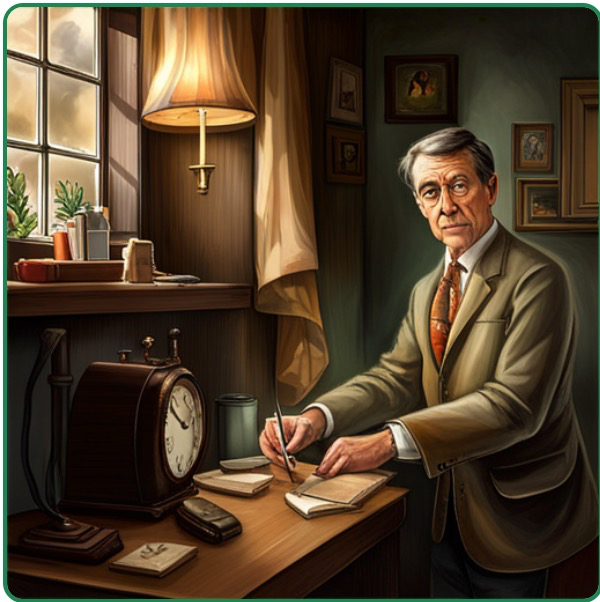
Mr. Picklefoot was not amused. It was 7 a.m., and he needed to prepare for the day’s first house call. He also wanted another cup of coffee and a second scone with strawberry jam.
“Bad dog, Skip!” he shouted, waving a finger at his dog. Skip looked down at his paws.
Just then, a blue Oldsmobile sedan slowed and stopped before them. A power window hummed as it slid down.
“Mr. Picklefoot!” exclaimed the lady behind the wheel. She was about 75 with gray hair pulled back into a neat bun. “Am I ever glad to see you! My clocks need adjusting, and my smoke alarms need fresh batteries. It’s complete chaos.”
“Mrs. Knowles, it is nice to see you,” Mr. Picklefoot said, still somewhat winded from his exertions with Skip and the squirrel. “My appointment book is nearly full, but I am happy to squeeze you in for a visit as long as you don’t mind it being this evening. My last appointment is at 6 p.m. so it would be after that. Probably closer to 7 p.m.”
Mr. Picklefoot was the owner and sole proprietor of “Time is of the Essence.” His establishment specialized in setting things right following the two disruptive days associated with daylight saving time each year. With packages starting at $19.95, he would come to your home or business to adjust all clocks and replace the batteries in all smoke alarms. The service included wristwatches, both digital and mechanical.
He was always quick to correct people who referred to the clock-adjusting ritual as daylight savings time. “It’s daylight-saving time, not “savings time,” he would shriek. He’d add that the term has no hyphen if it were over email.
He spent 363 days of the year repairing mechanical watches and clocks. He never took time for a vacation or even a day off. Skip was the store’s mascot and chief customer greeter.
“7 p.m. is fine, Mr. Picklefoot,” Mrs. Knowles said, looking down at Skip. She was allergic to dogs. “I am just so relieved that you have any time.”
“I always make time when time is of the essence,” he said. “Time is money, after all.” With that, he smiled and tipped his baseball cap. Then Skip saw another squirrel and their conversation ended abruptly.
Chapter 2
As Mr. Picklefoot and Skip continued their walk, they made their way through the quiet suburban neighborhood. The houses were neatly lined along the tree-lined streets with clocks requiring precise attention.
Skip was still on high alert, his eyes darting from tree to tree, looking for any more squirrels that might tempt him into another chase. Mr. Picklefoot, on the other hand, was mentally organizing his schedule for the day. He had a list of appointments to keep, each with its unique set of timepieces and smoke alarms needing adjustment.
The morning sun was beginning to warm the air, and the scent of freshly mowed lawns and blooming flowers filled the neighborhood. It was moments like these that Mr. Picklefoot cherished the most—when he could take a break from the hustle and bustle of his busy schedule and enjoy a stroll with his loyal companion.
Turning a corner, they encountered Mrs. Ramirez, a young mother with a toddler. The little girl clutched a stuffed bunny and looked up at Mr. Picklefoot with wide, curious eyes.
“Hello, Mrs. Ramirez,” Mr. Picklefoot greeted her warmly. “How are you and little Sophie doing today?”
Mrs. Ramirez smiled; her eyes tired but kind. “We’re good, Mr. Picklefoot. But our wall clock in the living room has been running slow for weeks, and it’s driving me crazy. Can you fix it?”
Mr. Picklefoot nodded. “Of course, I can. I’ll pencil you in for tomorrow morning, say around 10 a.m.? Will that work for you?”
“That’s perfect,” she replied with a sigh of relief. “Thank you so much. Sophie loves to watch the clock, and explaining why it’s always wrong has been hard.”
As they continued their walk, Mr. Picklefoot made a mental note to bring a small toy for Sophie on his next visit. He had a soft spot for children and always tried to make their clock adjustments a memorable experience.
After a few more blocks, they reached the local park. The sun was now entirely in the sky, casting a warm, golden glow over the playground. Children ran around, laughed, and played on the swings and slides. Skip wagged his tail excitedly, eager to join in the fun, but Mr. Picklefoot gently tugged on his leash.
“Not today, Skip,” he said. “We have work to do.”
As they left the park behind, Mr. Picklefoot couldn’t help but reflect on the importance of his job. In a world that was constantly rushing forward, he was the one who ensured that time itself remained steady and reliable for his customers. It was a responsibility he took seriously, and he wouldn’t have it any other way.
With each step, he and Skip continued their walk, ready to face the challenges and quirks of time that awaited them in the quaint suburban neighborhood they called home.
Chapter 3
The evening had settled in, and Mr. Picklefoot was preparing for his appointment with Mrs. Knowles. He carefully packed his toolkit, making sure he had all the necessary tools to adjust her clocks and replace the smoke alarm batteries. Skip watched intently, his tail wagging with anticipation.
At 7 p.m. sharp, Mr. Picklefoot arrived at Mrs. Knowles’ cozy home. She greeted him at the door with a warm smile and a plate of freshly baked chocolate chip cookies.
“Mr. Picklefoot, thank you for coming,” she said, leading him to the living room. “Please, make yourself comfortable.”
Mr. Picklefoot got to work, meticulously adjusting each clock in Mrs. Knowles’ home. She watched in fascination as he carefully synchronized each timepiece, explaining the intricacies of his craft. Despite her initial stress, Mrs. Knowles found herself enjoying the process and Mr. Picklefoot’s company.
As the last clock ticked into perfect alignment, Mr. Picklefoot replaced the batteries in the smoke alarms. He checked them all to ensure they were functioning correctly. Mrs. Knowles was impressed with his attention to detail.
“Everything looks perfect now, Mrs. Knowles,” Mr. Picklefoot declared with a satisfied smile. “Your home is in sync with time itself.”
Touched by his dedication and expertise, Mrs. Knowles handed Mr. Picklefoot a small envelope. “I know you charge a fair price for your services, but please take this as a token of my gratitude.”
Mr. Picklefoot opened the envelope and found a handwritten thank-you note and a generous tip. He was genuinely touched by her kindness and thanked her profusely.
Chapter 4
The following day, Mr. Picklefoot promptly arrived at Mrs. Ramirez’s home at 10 a.m. Sophie, the curious toddler, was eager to meet him again. This time, Mr. Picklefoot had brought a small wind-up toy for her—a little clockwork bunny that hopped and clicked as it moved.
Sophie’s eyes lit up with delight as she received the gift. “Thank you, Mr. Picklefoot!” she exclaimed.
Mr. Picklefoot smiled warmly. “You’re very welcome, Sophie. Now, let’s take a look at that wall clock of yours.”
He carefully examined the clock, diagnosing the issue and making the necessary adjustments. Sophie watched with fascination, asking questions about gears and hands as Mr. Picklefoot worked his magic.
With the clock now keeping perfect time, Mr. Picklefoot handed Sophie a tiny screwdriver. “Would you like to help me, Sophie?”
Her eyes widened, and she nodded eagerly. Together, they tightened a few screws on the clock’s back cover. Sophie beamed with a sense of accomplishment.
As Mr. Picklefoot bid farewell to Mrs. Ramirez and Sophie, he couldn’t help but feel that he had made a small difference in their lives. It was moments like these that made his work truly rewarding.
Chapter 5
As the days passed, Mr. Picklefoot continued his rounds, ensuring that time was accurate and reliable for all his customers. He encountered various challenges, from antique grandfather clocks that required delicate restoration to modern digital timepieces with complex settings. Each appointment brought its unique story and connection with the people he served.
Chapter 6
One sunny afternoon, Mr. Picklefoot received a call from the local elementary school. Their tower clock, a cherished community landmark, had stopped ticking. The principal, Mrs. Johnson, was in a panic as the upcoming school play depended on the clock’s accurate timekeeping.
Mr. Picklefoot rushed to the school, accompanied by Skip. He carefully climbed the clock tower, with Skip watching from below. After a thorough examination, he discovered a worn-out gear that needed replacement. He replaced the gear with great precision, and soon, the clock was ticking again.
Mrs. Johnson was overjoyed. “Mr. Picklefoot, you’ve saved the day! Our play can go on as scheduled.”
Skip barked happily, and Mr. Picklefoot couldn’t help but feel pride in his work. He knew that his dedication to keeping time was not only about clocks but about keeping communities connected and thriving.
Chapter 7
As the seasons changed, Mr. Picklefoot’s reputation continued to grow. People from neighboring towns began to request his services, and he traveled further to meet their needs. Skip, the ever-loyal companion, accompanied him on his journeys, becoming a beloved figure in every community they visited.
Chapter 8
One evening, as Mr. Picklefoot and Skip returned from a particularly long day of clock adjustments, they walked through the park where children still played. Now a bit older, Sophie spotted Mr. Picklefoot and ran over with a bright smile.
“Mr. Picklefoot! Look at my clock!” she exclaimed, showing him a homemade cardboard clock, she had decorated.
Mr. Picklefoot knelt; his heart warmed by the sight of Sophie’s creativity. “That’s a fantastic clock, Sophie! You’ve done a wonderful job.”
She beamed with pride. “I want to be like you when I grow up, Mr. Picklefoot. I want to make sure time is always right for everyone.”
Touched by her words, Mr. Picklefoot patted Sophie’s head. “You’ll make a fantastic timekeeper, Sophie. Just remember, time is precious, and what we do with it matters most.”
And so, the story of Mr. Picklefoot, the dedicated timekeeper, and Skip, his faithful companion, ends. Their journey through the world of clocks and time had kept time accurate and touched the lives of many in their community and beyond. They had shown that in a world constantly on the move, sometimes all it took to make a difference was a little time and a lot of heart.
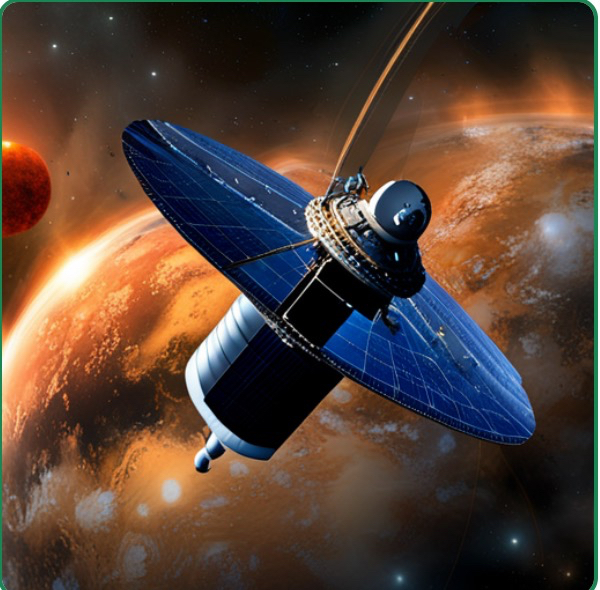
In the crimson glow of the Martian dawn, New Earth City rose like a phoenix from the barren landscape. Nestled within the confines of an enormous transparent dome, the city stood as a testament to humanity’s audacity and ingenuity. It was a city unlike any other, an oasis of life on the dusty, alien planet.
For years, scientists, engineers, and pioneers from every corner of Earth had collaborated on an audacious plan to terraform Mars. After decades of relentless effort, they had transformed the once lifeless, frigid wasteland into a world teeming with life. The Martian air had been thickened, the temperatures stabilized, and an artificial magnetic field had been created to protect the city from deadly solar radiation.
At the heart of this thriving metropolis was New Earth City, a genuinely international city-state. It was not beholden to the interests of any nation on Earth but governed itself as a self-sustaining ecosystem. Under the colossal dome, the city sprawled across the Martian landscape, divided into distinct districts that mirrored the diversity of Earth’s urban environments.
The Financial District gleamed with towering skyscrapers, housing the offices of multinational corporations, banks, and financial institutions. The Martian Stock Exchange, a hub of interplanetary commerce, buzzed with activity. People from all over Earth flocked here, seeking opportunities amidst the thriving interstellar economy.
In the Industrial District, the relentless hum of manufacturing plants and assembly lines filled the air. Advanced robotics and automation had made it possible to produce everything from spacecraft components to consumer goods with remarkable efficiency. New Earth City had become a beacon of technological progress, exporting its cutting-edge innovations to colonies across the solar system.
Nestled on the outskirts of the city was the Residential District, a tranquil haven where cozy houses with tidy fenced yards dotted the Martian landscape. Families from every corner of Earth had made New Earth City their home, drawn by the promise of a better life on Mars. Children played in lush parks, and dogs frolicked in the specially designed Martian dog parks, enjoying the thrill of bounding in the lower gravity.
Among the city’s residents, one figure stood out—a friendly android named Max and his robotic dog, Spark. Max had been built with a unique purpose—to assist and befriend the people of New Earth City. He walked among the humans, his artificial intelligence programming perfectly mimicking human emotions and behaviors. Max had a knack for making everyone feel at ease, and his compassion had endeared him to many.
One day, as Max and Spark strolled through the tranquil Residential District, they came across a group of children playing with a holographic soccer ball. Max’s digital eyes twinkled with delight as he joined in the game, showcasing his exceptional agility and precision. The children laughed and cheered, embracing Max as one of their own.
As the sun dipped below the Martian horizon, Max and Spark continued their walk, spreading joy and companionship wherever they went. They were not just residents of New Earth City; they were its heart and soul, a testament to humanity’s ability to create new beginnings even in the most inhospitable of environments.
In New Earth City, amid the gleaming skyscrapers, the bustling factories, and the cozy homes, Max and Spark reminded everyone that the human spirit, even when crafted from circuits and wires, could shine brightly and foster a sense of community and belonging. They were living proof that on Mars, humanity had not just built a city; they had built a new world.
Captain Amelia Grayson and Commander Ethan Hayes sat side by side in the cramped cockpit of the intergalactic spacecraft, their eyes fixated on the intricate control panel in front of them. The hum of the spacecraft’s engines filled the cabin as they hurtled through the inky void of space toward an object so mysterious and ominous that it had long been considered the final frontier of the universe—the event horizon of a black hole.
The two astronauts were pioneers on a mission that had captivated the imagination of every being in the galaxy. It was the first-ever attempt to learn what lay on the other side of a black hole, a venture that was equal parts daring and dangerous. They had trained for years mentally and physically for this moment, and now, the moment was upon them.
“Approaching event horizon in three minutes,” Captain Grayson announced, her voice steady despite the nerves that gripped her. She adjusted her grip on the control yoke, her gloved fingers tracing the sleek curves of the spacecraft’s interface.
Commander Hayes, his heart pounding in his chest, glanced at the small video screens that displayed vital telemetry data. The numbers danced and flickered, a testament to the colossal gravitational forces at play. “All systems are green, Captain,” he reported, his voice tinged with anticipation.
The spacecraft, aptly named “Stardiver,” glided ever closer to the swirling abyss of the black hole, its colossal maw seeming to devour the very essence of space and time itself. As they approached, the event horizon cast an eerie, distorted glow, bending and warping the starlight around it. It was as if the laws of physics themselves were being rewritten.
The minutes felt like an eternity as the spacecraft inched closer and closer to the point of no return. Captain Grayson and Commander Hayes held their breath, their suits filled with the sound of their own hearts thumping in their chests.
“Entering the event horizon now,” Captain Grayson declared, her voice tight with determination.
Time itself seemed to slow as the Stardiver crossed the threshold into the black hole, and the laws of physics seemed to unravel. Outside the cockpit, the stars stretched and bent in ways that defied explanation. It was as if they were witnessing the birth of a new reality.
Inside the cockpit, the control panel flickered and danced with erratic energy. The spacecraft’s instruments struggled to make sense of this strange new realm. The small video screens displayed images that were both awe-inspiring and terrifying—hypnotic swirls of light and color that defied comprehension.
Captain Grayson and Commander Hayes were lost in the surreal beauty of the unknown for what felt like an eternity. They had dared to tread where no one had gone before, and now they were on the cusp of discovering the secrets that lay on the other side of a black hole.
As they journeyed deeper into the enigmatic heart of the singularity, they realized they were no longer in control. The laws of physics, once their steadfast companions, had abandoned them. The spacecraft’s systems failed one by one, succumbing to the incomprehensible forces of the black hole.
In their final moments, as the cockpit disintegrated around them, Captain Grayson and Commander Hayes looked at each other, their expressions a mix of fear and wonder. They knew they might never return but had achieved what no one had ever dared to dream.
Their sacrifice would be remembered for eternity, a testament to the boundless human spirit and the insatiable thirst for knowledge that drove them to explore the edges of existence. As the black hole swallowed them, they held onto the hope that their journey would someday yield answers to the universe’s greatest mysteries, answers that would forever change humanity’s understanding of reality.
Part I explained some examples of the AI tools I use to create stories and accompanying art. It’s a disjointed process, as neither category of these AI tools can do both (yet). For text, you need to use a language model-based chatbot and for images, an art-generator app.
Language model-based chatbots are unique because they can write computer code, movie/video scripts, essays, blog and social media posts – and much more.
As a writer, I immediately saw the benefits of AI in my craft. For example, there was a short story I’d been working on (and then set aside) for years. I just couldn’t come up with an ending. I copied and pasted a summarized version into ChatGPT and asked it to “finish the story.” It did! And I was impressed.
The user interface of every AI generator I’ve used to date is rather underwhelming: A narrow Google-like text box. This suggests that concise prompts are encouraged – but I’ve used as many as 1,500 words for both ChatGPT (mainly for testing purposes). Hoolock limits entries to 1,000 characters, which is about 250 words.
ChatGPT
Hoolock
ChatGPT and Hoolock offer some suggestions to get started if you are new to these AI tools. But I use them a bit differently.
After work (and a cold beverage), I sometimes get an idea for a short story in my head that – without AI – I’d jot down for later consideration. But with AI at my fingertips, would it kill me to spend 30 seconds entering the idea into one of my two new creative tools? No!
This morning I wrote the following introduction to a fictional account of a fishing boat that was being overtaken by a storm:
The small fishing boat bobbed violently as the choppy waves kicked up by the hurricane continued to pummel the ship. Counter to his best efforts to outrun the tempest, the mighty storm was overtaking the two-man craft.
“Secure the nets, Mr. Schmitt!” Capt. Pauly shouted to his first mate. “We’ve no choice but to ride this out to the end!”
I titled it “Capt. Pauly’s Plight.” This is what a plugged into ChatGPT:
If you want to know how this tale ends, visit my blog – ChatGPT picked up where I left off here!
I then used what I had written along with a paragraph or two that ChatGPT contributed and pasted that text into Hoolock. Here’s the art that popped out the other end:
While I donated this piece to support “disaster relief,” I took a screen grab of just the image to use in my blog post. I took the liberty of doing so since I’m the author – but soon, the founders of Hoolock will make it possible to link the image back to their site for purchase considerations. It’s on the roadmap, they told me!
Once upon a time in the picturesque coastal town of Shorehaven, renowned master architect John Ellis faced one of the most challenging projects of his illustrious career. His client was none other than the billionaire real estate developer, Hugh Shipley, a man known for his discerning taste and exacting standards.
Once upon a time in the picturesque coastal town of Shorehaven, renowned master architect John Ellis faced one of the most challenging projects of his illustrious career. His client was none other than the billionaire real estate developer, Hugh Shipley, a man known for his discerning taste and exacting standards.
Shorehaven had always been a haven for sailors and fishermen, but Hugh Shipley had a vision that surpassed the town’s humble origins. He wanted to create a landmark that would not only guide ships safely through treacherous waters but also stand as a testament to his wealth and influence. And he had chosen John Ellis to make his vision a reality.
Ellis knew from the very beginning that Shipley’s demands would push the boundaries of architectural imagination. The billionaire was adamant about an eight-story lighthouse, a structure that dwarfed any other lighthouse in the world. He wanted it to be a symbol of his success, visible from miles out at sea.
As John Ellis delved into the project, he found himself navigating a sea of challenges. The lighthouse had to be not just tall, but also incredibly sturdy to withstand the harsh coastal weather. It had to incorporate state-of-the-art lighting technology to guide ships safely, and it needed to have a design that was both functional and aesthetically pleasing.
For months, John worked tirelessly, pouring over blueprints, conducting feasibility studies, and consulting with experts from various fields. He tested multiple architectural concepts, pushing the boundaries of engineering and design. The process was grueling, and there were moments when he doubted whether he could meet Shipley’s demanding specifications.
But John Ellis was not called a master architect for nothing. His passion for architecture, his dedication to perfection, and his unwavering commitment to his craft drove him forward. He put in long nights and early mornings, refining the plans until they were nothing short of a masterpiece.
Finally, the day came when John Ellis presented his final plans to Hugh Shipley. The billionaire sat in his opulent office overlooking the tranquil waters of Shorehaven Bay, examining the blueprints with a critical eye. John held his breath, his heart pounding in anticipation.
After what felt like an eternity, Shipley looked up from the plans and smiled. It was a smile of approval, a smile that meant success. He nodded, his eyes shining with satisfaction.
“Ellis, you’ve outdone yourself,” Shipley said. “This is magnificent. It’s everything I envisioned and more.”
Relief washed over John like a tidal wave. He had not only met Shipley’s demanding expectations, but he had exceeded them. The grand eight-story lighthouse was a masterpiece of architectural innovation, blending form and function seamlessly.
With a handshake and a contract signed, the construction of the lighthouse was set to commence in the coming spring. The town of Shorehaven buzzed with excitement as the news spread. John Ellis had not only created a symbol of maritime safety but had also left an indelible mark on the town’s history.
As the construction crews began their work, the towering lighthouse rose steadily, a testament to the collaboration between a demanding client and a master architect who had risen to the challenge. It would soon stand as a beacon of hope and a symbol of achievement, guiding ships safely home while reminding everyone that, with dedication and vision, even the most ambitious dreams could become a reality.
As the USS Broderbund glided through the vast expanse of space, the bridge lights dimmed, and a sense of tranquility filled the room. Captain Griggs and the five bridge officers made their way to the cryostasis pods positioned in a semi-circle at the back of the control room. These pods were state-of-the-art technology, ensuring the safety and well-being of the crew during their extended journey.
One by one, the officers entered their pods. The process was familiar, but the anticipation was always tinged with a hint of anxiety. As they settled into their chambers, Captain Griggs looked around at the dedicated team that had become like family over the years. Their commitment to this mission, to humanity’s exploration of the solar system, was unwavering.
With a nod of assurance, Captain Griggs stepped into his cryostasis pod. He felt a momentary chill as the pod’s lid sealed shut, locking him in a cocoon of preservation. The ship’s AI, known as “AURA,” took over the final preparations, ensuring all systems were “GO” for the long journey ahead.
In the darkness of their pods, the crew members could feel the gentle hum of the ship’s engines and the soothing sound of AURA’s voice, providing a final update before initiating the cryogenic process.
“Preparing for stasis. All systems nominal. Cryogenic suspension sequence initiated. Sweet dreams, Captain Griggs and crew.”
As the crew drifted into their deep slumber, the Broderbund continued its trajectory toward Europa. Over the next three years, the ship would sail through the cosmic ocean, silently and tirelessly, until it reached its destination. AURA, the ever-watchful guardian of the vessel, monitored every system, ensuring that the crew would awaken safely when the time was right.
During their journey, the crew members dreamed of the adventures that awaited them on Europa, of the mysteries they would uncover beneath its icy surface and the contributions they would make to the future of interplanetary exploration. They knew this mission was a testament to human ambition and the unyielding spirit of discovery.
And so, in the vastness of space, the U.S.S. Broderbund and its crew sailed onward, a beacon of human determination, with the promise of a new world awaiting them on the icy moon of Europa.
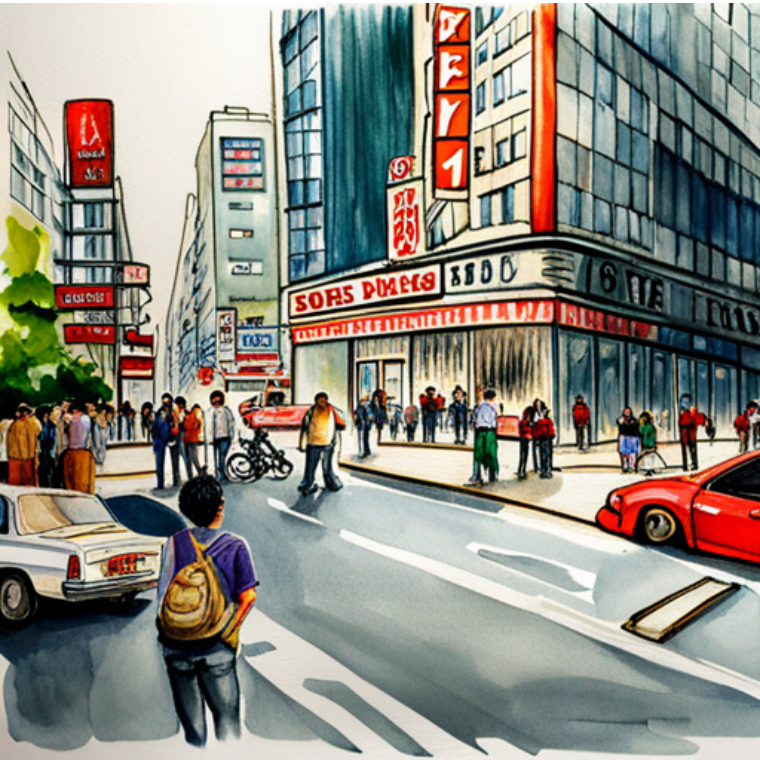
Jas Doyle had always been fascinated by Tokyo’s Akihabara district. Known as “Electric Town,” it was a kaleidoscope of neon lights and a cacophony of electronics, a sensory overload for anyone walking its streets. For a tech-savvy American journalist like Jas, it was a paradise.
Jas was in Tokyo on an assignment for an international tech magazine, covering the latest innovations in Japanese gaming and electronics. He was right at home among the otaku, the diehard fans of anime, manga, and video games. Jas had always respected their passion for the medium, and he knew that the otaku of Akihabara were the lifeblood of the district.
One evening, as the sun dipped below the horizon, casting a purplish hue over the bustling streets, Jas found himself in the heart of Akihabara. He was chatting with a group of otaku who were explaining the intricate details of the latest virtual reality headset when the atmosphere suddenly changed. An eerie silence swept through the crowd, and the neon lights seemed to flicker in unison.
Jas’s instincts kicked in, and he turned toward the source of the commotion. At the entrance to a narrow alleyway, he saw a group of well-dressed men in black suits. Even in the dim light, their tattooed arms and menacing presence were unmistakable – members of the Yakuza.
The otaku around him began to disperse, their enthusiasm for tech overshadowed by fear. Jas knew he had to document what was happening; it was his journalistic duty. He discreetly took out his smartphone and began recording, making sure to stay behind a corner, partially hidden from view.
In the alleyway, a heated argument was unfolding between two Yakuza members. Jas strained to hear their words over the ambient noise. It became apparent that this was no ordinary dispute. It was a power struggle within the Yakuza, and tensions were running high.
Suddenly, one of the Yakuza members drew a concealed knife from his suit. Before anyone could react, he lunged at his rival with deadly precision. Blood sprayed across the narrow alley, and a collective gasp rippled through the onlookers. The victim fell to the ground, lifeless.
Jas’s heart raced as he continued to capture the grim scene on his phone. He knew he had to get the footage out to the world, but he also had to stay hidden from the dangerous men now cleaning their blades in the alley.
As the assailant turned to leave, he glanced in Jas’s direction. Panic gripped Jas as their eyes met briefly. He knew he had to act quickly. He backed away, slipped behind a stack of electronics crates, and then made a dash for the nearest exit, praying he wouldn’t be noticed.
Once back on the bustling streets of Akihabara, Jas called the police, providing them with the footage he had captured. He had a duty to the truth, and this violent assassination must be exposed. But he also knew that he had put himself in grave danger.
The following days were tense as Jas cooperated with the Japanese authorities, who were able to identify and apprehend the Yakuza member responsible for the murder. The incident sent shockwaves through Tokyo, putting Akihabara’s vibrant community on edge. But it also underscored the importance of truth and justice, even in dangerous circumstances.
Jas Doyle’s reporting made headlines worldwide, shedding light on the dark underbelly of Tokyo’s criminal underworld. He had ventured into Akihabara as a curious journalist. He emerged as a witness to a violent crime, a testament to the power of a free press and the determination to reveal the truth, no matter the risks.










 The Diederich Journal