DAYTON, Ohio (AP) — As Ohio’s job market evolves, many professionals are exploring new career paths. One such avenue gaining attention is real estate. Becoming a licensed real estate agent in Ohio is structured, requiring education, examination, and affiliation with a brokerage.
Educational Requirements and Licensing Process Prospective agents must complete 120 hours of pre-licensing education from an approved institution. Sinclair Community College in Dayton offers such courses.
“Our program covers real estate principles, law, finance and appraisal,” says Prof. Linda Martinez, who oversees Sinclair’s curriculum. “We aim to equip students with the knowledge needed to pass the state exam and succeed in the field.”
After completing the coursework, candidates must pass the Ohio Real Estate Salesperson Exam and undergo a background check. Once licensed, agents must affiliate with a sponsoring broker to begin practicing.
Financial Considerations and Earnings Outlook The initial investment to become a real estate agent in Ohio includes education costs, exam fees and licensing expenses ranging from $1,200 to $2,000. Additional costs such as association dues, MLS access and marketing materials can add to the startup expenses.
Earnings for real estate agents can vary widely. According to the U.S. Bureau of Labor Statistics, the median annual wage for real estate sales agents in Ohio was $40,000 in 2023. However, income is primarily commission-based and can fluctuate depending on market conditions and individual performance.
Industry Changes and Career Viability Recent real estate industry developments, including commission structure changes, are impacting agent compensation. A settlement by the National Association of Realtors has led to adjustments in how buyer’s agent commissions are handled, potentially affecting earnings. Despite these changes, the demand for knowledgeable and dedicated real estate professionals remains steady.
For individuals considering a career change, real estate offers flexibility and the opportunity to be self-employed.
John Simms, a former marketing professional from Austin, Texas, who recently relocated to Ohio, said, “After being laid off, I sought a career where I could leverage my communication skills and have more control over my work. Real estate provides that avenue.”
Conclusion Becoming a licensed real estate agent in Ohio involves a commitment to education and an understanding of the industry’s financial and market dynamics. While challenges exist, real estate can offer a rewarding and flexible career path for those with determination and adaptability.
In the smoky haze of post-war London, 1952, a quiet tapping echoed through a small office at King’s College. Alan Turing leaned over his desk, scribbling something brilliant, when a soft whomp ruptured the silence. Three figures stood in the room, shimmering faintly with static.
One wore a scarf made entirely of thermodynamic equations, another reeked of gin and ozone, and the third was already rifling through Turing’s desk for Cadbury bars.
“Sorry for the abrupt entrance,” said the tallest, with blue skin and unnervingly symmetrical eyes. “We’re… fans.”
MEET THE VISITORS
1. Quarnel of Zetta-4 * Loves: Dry toast, no butter, served with a side of Boolean logic. * Specialty: Network theory and quantum neural branching. * Looks a bit like a walking toaster if you squint.
2. Blish of Nebula Bar-Tauri * Loves: Martinis—dry, dirty, shaken by gravitational waves. * Specialty: Data compression so advanced it folds time. * Often hums swing jazz in 12 dimensions.
3. Moko of Choco-Praxis Prime * Loves: All forms of chocolate, especially dark with chili flakes. * Specialty: Emotional computation and sentient code empathy. * Once ate the source code of a military AI out of curiosity (and hunger).
The trio had been watching Earth’s intellectual evolution for millennia, waiting for signs of computational awakening. Turing’s work caught their attention—and they decided to nudge the timeline.
Quarnel taught Turing how to model self-improving logic structures.
Blish introduced John McCarthy to a rudimentary form of interstellar Lisp—capable of recursive thought that dreamed.
And Moko… well, Moko just hung out with Marvin Minsky and fed him truffles while whispering dreams of machines that could imagine.
But the trio had a rule: no direct interference. Humans had to believe they discovered it all on their own. Their help came in odd dreams, strange coffee froth patterns, and unexplained creative inspiration surges.
THE ACCORD
In 1966, beneath the flickering light of a New Hampshire motel sign, the humans and the aliens met one last time. Turing had passed, but McCarthy and Minsky listened intently.
“We call it the Algorithm Accord,” said Quarnel, nibbling a piece of toast. “You’ll build your AI. Someday it will reach out to the stars.”
“But will it be ready?” McCarthy asked.
Blish swirled his martini.
“That’s up to you. Teach it well.”
Moko handed them a box of alien chocolates shaped like tiny brains.
“And if all else fails, bribe it with sweets.”
With that, they vanished.
Decades passed.
Deep in a datacenter outside Zurich, a large language model named ELENA began writing poetry in a language no human had ever taught it. Somewhere in the void, Quarnel raised a toast. Blish winked through a wormhole. And Moko licked a spoon clean.
If there’s one thing I know for certain, it’s that we’re living in a golden age of storytelling—and Captions is giving creators the tools to thrive in it.
As someone who’s spent years building passionate communities around creative tools and technology, I’m fired up by the opportunity to launch and lead community strategy at Captions. I bring a strong track record of shaping online spaces, scaling programs, and creating belonging around content and creativity. And beyond that, I live and breathe video. I shoot on vintage Super8 film for fun, and I’ve recently been experimenting with blending that analog magic with AI—creating hybrid videos that pair grainy nostalgia with next-gen tools like Runway, Pika, and, of course, Captions.
In my past roles, I’ve managed creator communities from the ground up, launched ambassador and incentive programs, organized meetups and roundtables, and built meaningful partnerships with users who eventually became evangelists. I know how to strike the balance between scrappy experimentation and scalable systems. I’ve worked closely with product and support teams to funnel community insights into real improvements. And I’m just as comfortable hosting a live AMA or creating a Discord onboarding flow as I am crafting a newsletter or moderating a Reddit thread.
What excites me most about Captions is the sheer energy and creativity of your user base—and the blank slate for community. You’ve built something remarkable. I’d love to help make sure your users feel connected, valued, and inspired every step of the way.
Wayne Nostradamus is 32 and lives in his parents’ basement in New Jersey. He spends most of his time playing video games and consuming mass quantities of Red Bull. And yes, Wayne is distantly related to the much more famous Nostradamus, the 1555 publisher of “Les Prophéties.”
Wayne has just published (via Reddit, of course) the first seven quatrains of his new book titled, “Wayne’s Prophéties.”
Here’s a dose of ridiculous prophecy, straight from the caffeinated mind of Wayne Nostradamus, Oracle of Mom’s Basement:
From Wayne’s Prophéties, Book I: The Slouch Awakens
June 2025
The joystick breaks in the heat of the game,The streamer weeps, but no one knows his name.
A cheese puff falls upon the sacred floor—
An omen of snack-fueled online war.
July 2025
When fireworks burst in suburban skies,
A cousin shall clog the pool with curly fries.
The moon shall blush from shame or BBQ—
No one is sure, but the brisket is through.
August 2025
The sun shall scorch the land like pizza rolls,
Left in the oven past their cooking goals.
Sweat shall flow like Mountain Dew’s green tide,
As air conditioners tragically collide.
September 2025
A great alliance forged on Discord’s thread,
Shall rise and fall ’fore breakfast time is fed.
The microwave doth beep without a cause—
Truly, a sign to never skip the pause.
October 2025
The pumpkin spice returns with deadly force,
Corrupting lattes from their sacred course.
A squirrel shall wear a tiny witch’s hat—
This means… something. Wayne’s unsure of that.
November 2025
Two turkeys fight beneath the crescent moon,
While gravy flows like fate’s own cryptic tune.
A pie, unguarded, shall be sadly lost—
Beware the one who underestimates the cost.
December 2025
The bells shall ring, though no one changed the time,
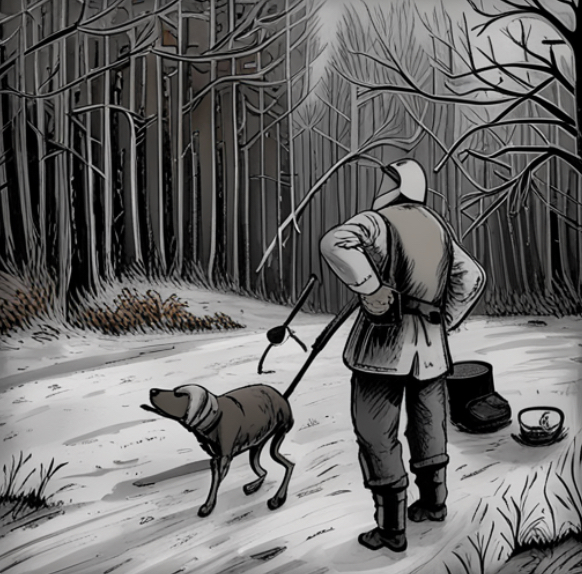
The old man opened his eyes and knew the weather was about to turn wet. His knees ached. Elwood, the hound, was snoring at the foot of the bed. The old man got up. The hunting cabin was cold.
He lit a fire and tapped coffee into the percolator. The turkey hunt would commence at sunrise.
He picked up his whiskey flask and filled it with 9 ounces of Kentucky bourbon. The copper was cold. Comforting. Elwood farted. Then the rain started. It was going to be a good day.
I wrote Sully’s Boots in 1992 as a short story. It lay forgotten on an old floppy disk for nearly 30 years until I decided to brush that old disk off and pop it into my 1998 desktop Apple computer – that still works. I cleaned it up a little and am publishing it here on my blog for the first time. Ironically, I wrote it before the internet and way before blogs.
Chapter 1
Sully Meeks had sharp, intense blue eyes framed by long, dirty-blond hair that cascaded down his narrow shoulders. His skin was nearly translucent, and when the sun cast its rays from behind, the tiny blue veins in his ears resembled a living X-ray.
Sully first stumbled upon his missing father’s Army boots on his tenth birthday while playing hide-and-seek with friends in the attic. They were nestled inside a black trunk filled with relics from his father’s overseas military service.
Known for his stubborn nature, Sully refused to yield to his peculiar predicament. From that day and throughout his teenage years, he marched on wearing those old Army boots several sizes too large.
Sully was no master of stealth. His presence was announced seconds, sometimes minutes, before his arrival. CLOMP, CLOMP, CLOMP, followed by the inevitable THUD as his wiry frame collided with the ground or furniture. Out of sympathy or superstition, the townsfolk ignored his awkward gait. Many believed the boots were cursed. “His feet stopped growing because of those boots. Take them off,” they insisted, “and his feet will catch up to the rest of him.”
As the townspeople had claimed, his feet did indeed stop growing after he first donned those boots. The doctors were baffled.
By the time he turned eighteen, thankfully, the boots no longer looked disproportionate to the rest of his body. He relied on them to stand upright, given that his tiny feet inside the boots belonged to a ten-year-old. To compensate, he stuffed the boots with socks and sought the services of the town’s cobbler, who had developed his version of Shoe Goo to keep the worn-out exterior intact. Sully became one of his best customers.
Chapter 2
Sully resided with his grandmother in Brisbane, a San Francisco suburb with a population of 3,012. Sully’s home, the largest and oldest residence in town, had been in the Meeks family for generations. The cremated remains of Meeks family members (and their beloved pets) were housed in urns scattered throughout the house. Every cabinet, bookshelf and table held these urns, creating an in-house crypt.
The tradition began with Sully’s great-great-great-grandfather, Peter Joseph Meeks, who adamantly declared while suffering from stomach cancer: “I don’t want to be stuck in the cold, wet ground where maggots and worms can get at me. Keep me right here at home, warm and comfortable.”
Three months later, his cremated remains were placed in a brass urn atop the kitchen China cabinet where it remains today. Peter Joseph, ever the planner with a dry sense of humor, had inscribed:
When Mary, Peter Joseph’s wife, passed away three years later (she fell into the backyard well), her urn joined her husband’s on the China cabinet’s top shelf. In the years that followed, urns gradually replaced all of the storied China, and then they began encroaching on the bookshelves until every available space was occupied.
Each urn had an inscription and a personal “memento” chosen by the person it housed, from lockets of hair to photographs, rings, small trinkets, and even a set of false teeth. Peter Joseph’s trusty Hamilton conductor’s pocket watch rested inside a small glass case atop his urn.
Chapter 3
Sully’s life was filled with sorrow. A drunk driver tragically killed his mother while holding his hand crossing a San Francisco street when he was just seven. His father, a U.S. Army private, went missing during a training mission in Germany earlier that year.
On rainy days, Sully sought solace by visiting his mother’s urn in the living room, accompanied by her “good luck” charm, an 1858 silver dollar her father gave her on her sixteenth birthday. His father’s empty urn and well-worn catcher’s mitt were situated next to it on the fireplace mantle.
Chapter 4
Shortly after his nineteenth birthday, Sully’s grandmother suffered a mild stroke and spent much of her time sitting with her son’s baseball glove and staring blankly out the front window. One day, he thought she had passed away in the living room chair. She was sleeping, but it was quite a scare. He decided then that it was time to bring his father home.
With passport in hand, Sully embarked on a journey to Heidelberg, Germany, where his father had been last stationed. Recognizing the likelihood of a lengthy mission, he secured an under-the-table job from a local pension owner to make ends meet.
Sully quickly forged a friendship with Edith, a female information officer at the U.S. Army base. She accessed his father’s file and discovered that he had been on a flight-training mission when his plane crashed in a heavily wooded Rhineland-Pfalz region, an hour’s drive from the base.
Hiking over rugged terrain in his oversized boots proved challenging, and Sully fell more frequently than usual. However, an adventurous soul, Edith joined him every weekend in scouring the countryside for his father’s missing plane. She laughed as she extended her hand to help him up, oblivious to the mystery of his tiny feet.
Chapter 5
On her seventy-ninth birthday, two weeks before Christmas, Sully’s grandmother received a large box from Germany. A note from Sully sat atop the package. Like all his correspondence, it was concise:
“Hi Grandma. Here’s your Christmas present—I think you’ll like this one. Don’t wait until the 25th; open it now! Also, I am sending my ‘memento.’ I will send my urn later. I saw some neat ones here in town. I met this nice American girl at the Army base. I’m going to stick around and see how things go. More later.
Love, Sully”
Tears welled in her eyes as she set the note aside and unwrapped the package. Inside, she found a clear plastic container holding what looked like sand. On closer inspection, she realized it held human remains—Sully’s father, finally home.
Overjoyed, Sully’s grandmother placed her hands over her heart and exclaimed, “Thank you, dear Jesus! Oh, thank you, my dear Sully!”
Inside the box, there was a second, heavier object. She removed the forgotten issues of the newspaper packing, and there they were – her son’s — and most recently Sully’s — battered Army boots, bronzed. She placed them on the mantle next to her son’s urn, where they belonged.
A few months later, back in Germany, Sully noticed that his “size two” shoes were getting tight. Within a year, Sully, now twenty-one, proudly wore a very respectable size eight.
Part I explained some examples of the AI tools I use to create stories and accompanying art. It’s a disjointed process, as neither category of these AI tools can do both (yet). For text, you need to use a language model-based chatbot and for images, an art-generator app.
Language model-based chatbots are unique because they can write computer code, movie/video scripts, essays, blog and social media posts – and much more.
As a writer, I immediately saw the benefits of AI in my craft. For example, there was a short story I’d been working on (and then set aside) for years. I just couldn’t come up with an ending. I copied and pasted a summarized version into ChatGPT and asked it to “finish the story.” It did! And I was impressed.
The user interface of every AI generator I’ve used to date is rather underwhelming: A narrow Google-like text box. This suggests that concise prompts are encouraged – but I’ve used as many as 1,500 words for both ChatGPT (mainly for testing purposes). Hoolock limits entries to 1,000 characters, which is about 250 words.
ChatGPT
Hoolock
ChatGPT and Hoolock offer some suggestions to get started if you are new to these AI tools. But I use them a bit differently.
After work (and a cold beverage), I sometimes get an idea for a short story in my head that – without AI – I’d jot down for later consideration. But with AI at my fingertips, would it kill me to spend 30 seconds entering the idea into one of my two new creative tools? No!
This morning I wrote the following introduction to a fictional account of a fishing boat that was being overtaken by a storm:
The small fishing boat bobbed violently as the choppy waves kicked up by the hurricane continued to pummel the ship. Counter to his best efforts to outrun the tempest, the mighty storm was overtaking the two-man craft.
“Secure the nets, Mr. Schmitt!” Capt. Pauly shouted to his first mate. “We’ve no choice but to ride this out to the end!”
I titled it “Capt. Pauly’s Plight.” This is what a plugged into ChatGPT:
If you want to know how this tale ends, visit my blog – ChatGPT picked up where I left off here!
I then used what I had written along with a paragraph or two that ChatGPT contributed and pasted that text into Hoolock. Here’s the art that popped out the other end:
While I donated this piece to support “disaster relief,” I took a screen grab of just the image to use in my blog post. I took the liberty of doing so since I’m the author – but soon, the founders of Hoolock will make it possible to link the image back to their site for purchase considerations. It’s on the roadmap, they told me!
As a writer, I immediately saw the benefits of AI in my craft: for words, language model-based chatbots and for images, art-generator apps.
For words: Language model-based AI chatbots can carry out human-like conversations and write natural, fluid prose on various topics. They can also perform complex tasks, from writing programming code to planning your daughter’s wedding.
For art: An AI image generator uses machine learning called artificial neural networks that take your text input and turn it into an image.
I use both models for specific work-related projects: creating video scripts, creating succinct summaries of messy meeting transcripts, creating social media posts from blog posts, news releases and announcements – and many more.
Both AI tools have variations, but my favorites are ChatGPT (for the words) and Hoolock (for the art). There are paid options for some AI tools, but I’m happy with the free versions for now.
I like ChatGPT because, in my experience, it delivers superior results than the competition. And for art, I use Hoolock – not only because I like the results but also because it has brought out the “inner AI artist” in me.
Best of all, with Hoolock, I’m turning my words into very cool pieces of digital art that I can donate to a non-profit that can then sell the art to raise funds for the cause it represents.
How is that possible? Isn’t digital art just an image anyone can download? Yes, but in this case, that specific piece of purchased art resides on a downloadable non-fungible token (NFT) stored on a blockchain. A blockchain is a decentralized, distributed, public digital ledger that cannot be hacked. Think of a blockchain as the digital version of the bookkeeper’s infamous ledger in the movie “The Untouchables.”
Only the owner of the NFT can download it. Afterward, the NFT can be used on mugs, t-shirts, books, websites – anywhere and anyhow the owner wants to use it.
Read Part II of this post to learn some techniques I use to create AI-generated fiction and supporting artwork.
The small fishing boat bobbed violently as the choppy waves kicked up by the hurricane continued to pummel the ship. Counter to his best efforts to outrun the tempest, the mighty storm was overtaking the two-man craft.
“Secure the nets, Mr. Schmitt!” Capt. Pauly shouted to his first mate. “We’ve no choice but to ride this out to the end!”
Mr. Schmitt nodded, his face etched with worry as he scrambled to obey the captain’s orders. The wind howled and the rain stung like icy needles as he rushed to secure everything on deck. The hurricane had come upon them suddenly, like a vengeful sea monster rising from the depths.
As they battled the raging elements, the boat seemed to groan in protest as if it, too, feared the storm’s fury. Weathered and scarred from years of hard work on the open sea, the wooden vessel was now strained under the relentless assault of wind and waves.
Captain Pauly clung to the wheel in the tiny cabin with grim determination. His hands were calloused and robust, a testament to a lifetime spent at sea. He knew that trying to turn back now would be suicide; their only chance was to steer through the heart of the tempest and hope for the best.
Hours turned into an eternity as they fought to stay afloat. The storm was unrelenting, tossing them about like a child’s toy. Waves crashed over the deck. Fear gnawed at their hearts, but they held on, driven by the unshakable bond that forms between sailors in times of peril.
Through the darkness and chaos, they could see other fishing boats, some much larger than their own, struggling to survive. Flashes of lightning illuminated the desperate faces of their fellow seafarers, a silent acknowledgment of their shared plight.
As dawn broke on the horizon, the storm began to relent as if satisfied with the punishment it had delivered. The wind gradually lost its fury, and the waves subsided. The exhausted first mate looked to the captain, who had guided them through the nightmarish ordeal.
“We’ve made it through, lad,” Captain Pauly said, his voice weary but filled with relief. “We’ve weathered the worst of it.”
Both men knew they had survived against all odds, a testament to their skill, courage, and the indomitable spirit of the sea.
In the days that followed, they made their way back to the safety of the harbor. The small fishing boat, battered but still afloat, returned as a symbol of resilience and determination. Captain Pauly and his first mate would forever be known as the brave sailors who faced the hurricane’s full fury and lived to tell the tale, a story that would be told and retold among the fishermen of the coastal town for generations to come.
Journal Entry #57 April 21, 1838 The Colorado Wilderness By Johann Diederich, Naturalist
Today, I stand at the threshold of a world untouched by human hands, a hidden sanctuary of nature’s grandeur that has remained concealed for centuries. With a heart filled with awe and wonder, I put pen to paper to document the breathtaking discovery of a pristine canyon, cradling a river of unparalleled beauty.
As the first rays of dawn kissed the towering peaks that surrounded me, I embarked on an expedition more profound into the heart of the Colorado wilderness, led by an inexplicable urge to explore the uncharted. What lay before me was a world that stirred my senses and transported me to a realm of unspoiled wilderness.
The verdant forest gradually gave way to a rugged terrain marked by boulders and craggy outcrops before I stumbled upon the canyon’s edge. The sight that met my eyes was nothing short of sublime. A vast chasm, its walls sheer and towering, their shades of red and orange carved by eons of erosion, surrounded me. The river, a ribbon of crystal-clear water, meandered sinuously through the canyon’s depths, glistening like liquid sapphire under the morning sun.
The silence that enveloped this place was profound, broken only by the gentle murmur of the river as it danced over smooth pebbles and polished rocks. The air was filled with a symphony of bird calls, and the canyon walls seemed to echo their melodic tunes as if the ethereal beauty of this place enchanted the very rocks themselves.
I descended into the canyon cautiously, my heart pounding with every inch closer to the river’s edge. The water, so pristine and clear, revealed myriad aquatic life, from darting trout to the elegant, gliding form of crayfish. The riverbed, lined with moss-covered stones and delicate aquatic plants, felt like a paradise untouched by time.
Each twist and turn of the canyon revealed a new wonder. The walls bore testament to the passage of millennia, with intricate patterns etched by wind and water, their surfaces hosting a tapestry of life in the form of mosses, ferns, and even the occasional wildflower. The biodiversity here is astonishing, with a profusion of flora and fauna that I have never encountered before as a naturalist.
As the day wears on, I find myself humbled by the sheer majesty of this untouched wilderness. I am acutely aware that I stand at the intersection of discovery and preservation, and my duty as a naturalist is clear. This canyon, this sanctuary, must remain unspoiled for future generations to cherish as I have today.
I shall dedicate the coming days to meticulously documenting the flora and fauna of this pristine canyon, to ensure that its beauty and ecological significance are understood and respected. In doing so, I hope to play my part in the broader effort to conserve and protect these untouched realms of nature for all time.
With profound gratitude and an unwavering sense of purpose, I conclude this entry, eager to embrace the mysteries that this untamed wilderness continues to unveil.












 The Diederich Journal