In the small coastal town of Cresthaven, nestled between the cliffs and the sea, there stood an old lighthouse that had watched over the town for generations. Its towering presence had safely guided countless ships to the harbor, and its light had been a beacon of hope in the darkest nights. But the lighthouse had a secret passed down from keeper to keeper for as long as anyone could remember.
The secret was called the “Ephemeris,” a mysterious book that held the power to predict the future. It was said to be hidden within the lighthouse; its pages filled with the destinies of the town’s inhabitants. Many have searched for it over the years. The lighthouse seemed to guard its secret fiercely, revealing its mysteries only to those it deemed worthy.
Lena was the latest in a long line of lighthouse keepers. She had grown up in Cresthaven, hearing stories of the Ephemeris from her grandmother. As a child, she had spent countless hours exploring the lighthouse, searching for hidden passages and secret compartments. Now, as the keeper of the light, she felt a deep longing to uncover the truth behind the legend.
One stormy night, as Lena climbed the spiral staircase to the lantern room, she felt a strange pull towards the bookshelf in the corner. It was a feeling she had never experienced before, as though an invisible hand was guiding her. She reached out and touched one of the dusty old books. It shifted slightly, revealing a hidden compartment behind it.
With trembling hands, Lena pulled out a leather-bound tome. The cover was weathered and worn, and the word “Ephemeris” was embossed in faded gold letters. She couldn’t believe her luck. The legendary book was finally in her hands.
Lena carefully opened the Ephemeris, and its pages came to life with intricate illustrations and cryptic writings. It was as though the book had been waiting for her all along. She began to decipher its secrets, discovering that it contained predictions of the future and instructions on how to change one’s fate.
Over the following weeks, Lena used the Ephemeris to help the people of Cresthaven. She prevented accidents, mended broken relationships, and even saved lives. The townsfolk marveled at her newfound abilities and hailed her as a hero.
But as Lena delved deeper into the Ephemeris, she realized the price of tampering with fate. There were unintended consequences for every action she took to alter someone’s destiny. The balance of the town’s life was shifting, and not always for the better. The more she tried to control the future, the more chaotic it became.
One evening, as the sun set over the cliffs, Lena climbed to the top of the lighthouse. She gazed out at the sea, the very sea that the lighthouse had protected for so long. She understood now that the power of the Ephemeris was too great for any one person to wield. It belonged to the town, to the collective destiny of Cresthaven.
With a heavy heart, Lena made a difficult decision. She returned the Ephemeris to its hiding place within the lighthouse, locking it away once more. She knew that the town needed its guidance, but it could not come at the expense of free will and the natural order of things.
As the years passed, Cresthaven thrived, guided by the lighthouse’s steadfast light. Lena remained the keeper of the light, but she had learned to trust in the ebb and flow of life, understanding that some mysteries were meant to remain unsolved.
The Ephemeris, hidden away in the heart of the lighthouse, held its secrets close, waiting for the next keeper to discover its power and, perhaps, its wisdom.
Life moved fast in the sprawling metropolis of Neotropolis, where towering skyscrapers touched the clouds during the day and vivid lights illuminated the streets at night
The year was 2145, and nanotechnology had woven itself into the very fabric of everyday existence. Robots, androids, and synthetic humans buzzed through the streets like busy bees, performing the dangerous and mundane tasks humans had once undertaken.
One particular establishment thrived amid the humming of gears and circuits right at the heart of the city. Ansel Bailey, a rugged man with salt-and-pepper hair and a passion for all things mechanical, owned the most popular diner in Neotropolis. His eatery, known simply as “Ansel’s,” was more than just a place to grab a quick bite; it was a haven for those who toiled in the world of wires and circuits.
Ansel’s diner stood proudly beside a worn yet trustworthy establishment: “No Bot too Broken.” It was a repair shop specializing in the intricate art of fixing the city’s non-human population. The shop was known across the city for its catchphrase, “Bots fixing bots,” a testament to the strange symbiosis between man-made machines and the humans who maintained them.
One brisk morning, as Ansel wiped down the stainless-steel counters of his diner, a familiar face walked through the door. It was Charlie, the owner of “No Bot too Broken.” He sported a grease-stained jumpsuit, his eyes concealed behind a pair of safety goggles.
“Morning, Ansel,” Charlie greeted as he sat at the counter.
“Morning, Charlie,” Ansel replied with a grin. “What brings you here today? Got some fried circuits in need of repair?”
Charlie chuckled, setting a small, damaged android on the counter. “You could say that. I had a bit of a mishap during a sewer inspection job. Need to replace a few parts and update the software.”
Ansel examined the damaged android, nodding thoughtfully. “I’ll have Sarah whip up a special blend for you while we await the repairs. You know, a little something to take the edge off.”
Charlie grinned in appreciation. “You read my mind, Ansel. You’re a lifesaver.”
As Ansel relayed the order to his head chef, Sarah, the two men settled into a comfortable conversation. They discussed the latest advancements in nanotechnology, the ever-evolving AI, and the ongoing debate about the rights of synthetic humans in a world where they do the most dangerous jobs.
Just as the aroma of freshly brewed coffee filled the air, Sarah emerged from the kitchen with a steaming mug for Charlie. He took a sip, sighing in contentment.
“I swear, Ansel, you make the best coffee in the city,” Charlie said with a grin.
Ansel chuckled. “Well, someone’s got to keep the gears turning around here.”
Their conversation continued as Ansel’s diner bustled with customers, both human and synthetic. It was a place where people could share stories, swap ideas, and even forge unexpected friendships between man and machine.
In the heart of Neotropolis, Ansel’s diner and “No Bot too Broken” stood as a testament to the enduring connection between humanity and technology. As the city raced forward into an ever-advancing future, these two establishments remained steadfast, reminding everyone that in the end, it was the human touch that made even the most complex machines feel alive.
Nestled in the heart of a boundless, cerulean sea lies the enchanting and mysterious island of No-Nish. This fantastical isle, shrouded in legends and whispered tales, is where the line between the ordinary and the extraordinary blurs into a world of pure wonder.
The Isle of No-Nish is a haven of lush, untouched landscapes, where emerald forests stretch as far as the eye can see, their ancient trees imbued with mystical energies that whisper secrets to those who dare to listen. The air is perfumed with the sweet scent of exotic blooms, and the sounds of melodious, unseen creatures echo through the vibrant foliage.
Wandering through No-Nish, visitors may stumble upon hidden glades where unicorns graze peacefully or discover sparkling, ethereal ponds where the water is rumored to grant wishes. The island’s shores are lined with pristine, ivory sands that sparkle like crushed diamonds beneath the golden sun, and the gentle waves beckon adventurers to explore their depths.
The inhabitants of No-Nish are a harmonious blend of mythical beings and ethereal creatures, living in harmony with the island’s mystical energies. Wizened wizards, merfolk, fire-dancing phoenixes, and mischievous forest spirits call this place home, adding to the island’s otherworldly charm.
Visitors who seek the island’s secrets are often drawn to the towering, crystalline spire at its center—a place of great power and ancient knowledge, guarded by enigmatic sentinels known as the Guardians of No-Nish.
But No-Nish is more than just a realm of magic and marvels; it is a place where the heart and soul find solace in the beauty of the natural world and the mysteries of the supernatural. Those fortunate enough to set foot on its shores may find themselves forever enchanted by the captivating allure of No-Nish, where the ordinary becomes extraordinary, and dreams are woven into reality.
INTRO: ELVIS PRESLEY’S LOS ANGELES HOME – AUGUST 27, 1965 – EVENING
The sun sets behind the palm trees, casting a warm, golden glow over Elvis Presley’s luxurious backyard. A long dining table is set up near the sparkling swimming pool. ELVIS PRESLEY, decked out in his signature black leather jacket and pompadour, sits at the head of the table. JOHN LENNON, PAUL MCCARTNEY, GEORGE HARRISON, and RINGO STARR, all looking dapper, sit on the opposite side. The sound of crickets fills the air.
ELVIS PRESLEY
(With a charming smile)
Well, boys, it’s great to finally have you here. You know, I’ve been a fan of yours for a long time.
JOHN LENNON
(Smiling)
And we’ve been fans of yours, Elvis. This is quite a treat for us.
PAUL MCCARTNEY
(Raising his glass)
Cheers to a night of good music and good company!
They all clink their glasses together.
GEORGE HARRISON
So, Elvis, what’s been happening in the world lately? Any news catching your attention?
ELVIS PRESLEY
(Leaning back)
Oh, you know, the world keeps turnin’. The Vietnam War is heating up, and there’s talk about civil rights everywhere. It’s a turbulent time.
RINGO STARR
(Nodding)
Aye, it’s tough out there. We’re just trying to spread some love with our music.
JOHN LENNON
Speaking of music, Elvis, we’ve got a new record coming out soon. We’re experimenting with some different sounds.
ELVIS PRESLEY
(Excited)
That’s fantastic, John! What can we expect from the Fab Four this time?
PAUL MCCARTNEY
(Grinning)
We’re trying some new stuff, you know, exploring different genres and pushing the envelope. It’s gonna be a surprise, for sure.
ELVIS PRESLEY
(Laughing)
Well, I can’t wait to give it a listen.
GEORGE HARRISON
(Changing the subject)
And what about you, Elvis? Any new movies in the works?
ELVIS PRESLEY
(Leaning forward)
Yeah, I’m working on a new film called “Paradise Hawaiian Style.” It’s gonna be a tropical adventure, lots of singing, and a few good fight scenes.
RINGO STARR
(Smirking)
Sounds like a classic Elvis movie to me!
JOHN LENNON
(Laughs)
We’ll make sure to catch it, won’t we, lads?
They all nod in agreement, enjoying their dinner and the warm California evening.
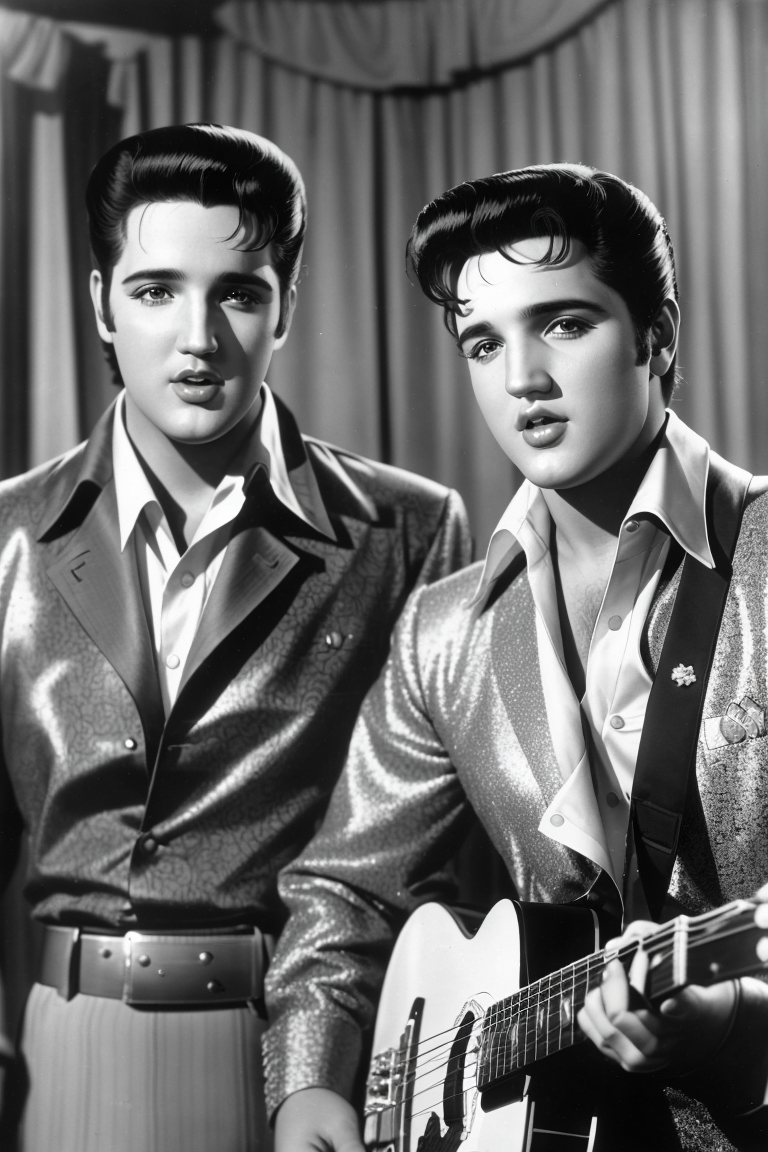
In the small town of Tupelo, Mississippi, on a chilly January morning in 1935, the Presley family welcomed not one, but two bouncing baby boys into their lives. Vernon and Gladys Presley’s joy knew no bounds as they cradled their twin sons, Elvis Aaron and Jessie Garon, in their arms. Both babies were healthy and full of life, and their laughter filled the humble two-room house.
As the years passed, Elvis and Jessie grew up as inseparable brothers and best friends. Their bond was unbreakable, forged in the shared experience of childhood adventures and mischief. They explored the lush woods surrounding their home, climbed trees, and built secret hideaways where they could retreat from the world. The town of Tupelo knew them as the inseparable duo, the two Presley brothers who were always seen side by side.
Elvis and Jessie shared not only their days but also their dreams. Their love for music blossomed early, with Elvis learning to play the guitar from his father and Jessie picking up the harmonica. Together, they would spend hours jamming on the front porch, their melodies carrying through the neighborhood like sweet Southern lullabies.
Their shared passion for music led them to form a band as teenagers, with Elvis as the charismatic lead singer and Jessie as the harmonica-playing heartthrob. They played at local venues and county fairs, wowing audiences with their raw talent and infectious energy. The girls in town couldn’t resist their charm, and the boys admired their unbreakable brotherly bond.
In 1953, as the duo graduated from Humes High School in Memphis, they faced a pivotal moment. Both dreamed of making it big in the music industry and decided to take a leap of faith together. They packed their belongings, instruments, and dreams into an old, beat-up car and set off for the vibrant music scene of Memphis.
Memphis proved to be a turning point for the Presley brothers. They hustled, performing at small clubs and bars, hoping to catch the attention of a talent scout. One fateful night, their electrifying performance at the Sun Studio caught the ear of legendary producer Sam Phillips. He recognized their potential and signed them to a record deal.
With Elvis as the charismatic frontman and Jessie’s soulful harmonica, they quickly rose to stardom. Their unique blend of rock, blues, and country music revolutionized the industry. The world fell in love with their raw talent and undeniable charisma.
Elvis and Jessie remained humble and grounded throughout their meteoric rise to fame, never letting the spotlight come between them. They shared every triumph and challenge, always supporting each other through the highs and lows of their incredible journey.
As the world knows them today, Elvis and Jessie stand side by side, not just as brothers but as a dynamic duo who forever changed the face of music. Their legacy lives on in the hearts of millions, a testament to the power of brotherly love and the magic they created together.
In the heart of the sprawling metropolis of NeoTech City, nestled amidst towering skyscrapers and shimmering neon lights, lay a place unlike any other: the Futuroid Emporium. This was no ordinary showroom; it was a futuristic haven where the wealthiest and most influential individuals from across the globe came to shop for their very own Android Workforce.
The Emporium was a technological marvel. Its facade, constructed from self-repairing nano-glass, seemed to morph and ripple, displaying mesmerizing holographic advertisements for the latest android models. Beneath its sleek exterior, a bustling hive of activity awaited those who dared to step inside.
As visitors crossed the threshold, they were greeted by a symphony of whirring gears and soft mechanical hums. The vast showroom was divided into sections, each dedicated to a different category of Android Workforce. From nimble assembly line robots to behemoth construction machines, every task deemed too dangerous or demanding for humans was catered to.
In the corner, an elegant lady in a sharp business suit was engrossed in a conversation with a holographic sales assistant. She gestured gracefully at a line of android surgeons, each equipped with state-of-the-art medical knowledge. “I’ll take three of those for my private clinic,” she declared with a confident nod.
Elsewhere, a middle-aged industrial magnate marveled at the android welders. His factory needed a workforce that could operate in extreme temperatures without risking lives. A salesman demonstrated the androids’ precision welding capabilities, and a deal was struck with a firm handshake.
In another section, a family with a child stared in wonder at the android educators. These androids possessed the ability to adapt their teaching methods to each student’s unique learning style, making them the perfect companions for children in need of personalized education.
The Emporium was staffed by android attendants, each impeccably dressed in formal attire and programmed to cater to the customers’ every need. They floated gracefully on anti-gravity platforms, their faces adorned with warm smiles, and their eyes exuding an otherworldly glow.
But the real stars of the showroom were the androids themselves. They moved gracefully and precisely, performing tasks with impeccable efficiency. Their artificial intelligence and machine-learning capabilities had evolved to the point where they could outperform humans in nearly every aspect of labor-intensive work.
At the center of it all was a towering statue, a tribute to the inventor who had pioneered this android revolution. Dr. Victor Ingrams had dedicated his life to creating a safer and more prosperous world. The Futuroid Emporium was a testament to his vision and the relentless march of technology into the future.
As the sun dipped below the horizon, casting an orange glow through the Emporium’s expansive windows, the showroom continued to buzz with activity. The Android Workforce was poised to reshape industries and redefine what it meant to work, all under the watchful gaze of NeoTech City’s elite.
In this futuristic world, the Futuroid Emporium was more than just a showroom; it was a symbol of human ingenuity and the boundless potential of machines programmed to do tasks too dangerous for humans. The future had arrived, and it was automated, efficient, and awe-inspiring.
The battle raged into its twentieth day, and the once-thriving city had been reduced to a war-torn wasteland. The Blue Flag side, desperate to gain an advantage, deployed its regiment of combat androids. These metallic soldiers marched in perfect formation toward the frontlines, their mechanical limbs moving with precision and purpose.
On the opposing side, the Red Flag forces were ready for the android onslaught. They sent their combat tanks rumbling forward, their massive turrets aimed at the approaching threat. The clash of technology and firepower was about to unfold in a spectacular and devastating display.
As the androids closed in on the Red Flag tanks, the air was filled with the deafening roar of artillery fire. Explosions erupted in brilliant bursts of orange and red, casting an eerie glow on the grim faces of the soldiers watching from the sidelines.
Amidst the chaos and destruction, the city’s skyline had become a jagged silhouette of crumbling buildings. Smoke and dust filled the air, making it hard to breathe. The once busy streets were now a nightmarish maze of debris, and the cries of the wounded echoed through the rain-soaked air.
As the androids continued their relentless advance, they faced a barrage of enemy fire. Red Flag tanks unleashed volleys of shells, sending shockwaves through the streets. Androids were torn apart, their mechanical bodies reduced to twisted wreckage. But they pressed on, relentless in their mission.
Meanwhile, the Red Flag tanks were not unscathed. Blue Flag forces had managed to damage some of them, causing explosions that sent flames and shrapnel flying. The battle had become a gruesome and relentless exchange of firepower, neither side willing to yield.
The rain fell steadily, adding to the misery of the combatants. The cold drops mingled with the sweat and blood of soldiers on both sides. The streets were now rivers of mud, and the city’s infrastructure lay in ruins.
Despite the destruction and loss of life, there were moments of heroism amid the chaos. Soldiers on both sides risked their lives to rescue wounded comrades, and medics worked tirelessly to tend to the injured. The horrors of war were etched into the faces of those who had survived this far.
As the battle raged on, it became increasingly clear that neither side would emerge victorious anytime soon. The war had taken a heavy toll on both the Blue Flag and Red Flag forces, and the city they fought for lay in ruins. It was a stark reminder of the devastating cost of conflict.
As the rain continued to fall, washing away the blood and smoke, the battle carried on into the night. The city’s once-vibrant streets were now a battleground, and the fate of its inhabitants hung in the balance. The twentieth day of the battle had come and gone, but there was no end in sight to the relentless struggle for control of the city.
The winter of 1937 had settled over Europe like a heavy blanket of snow, and the Orient Express, the epitome of luxury and opulence, was making its way through the frosty landscapes. Charles Davenport, the seasoned conductor of the renowned train, had seen many things in his years of service but nothing quite like what was about to unfold on this particular journey.
As the train chugged through the picturesque countryside of France, Charles adjusted his polished uniform and made his way down the narrow aisle of the first-class carriages. The click-clack of his black leather shoes resonated against the gleaming parquet floor. Bundled in furs and coats, passengers chatted softly while sipping hot beverages, their breath forming small clouds in the frigid air.
Stopping at Cabin 5, Charles rapped gently on the door and announced in his practiced, elegant tone, “Tickets, please. Tickets.”
The door opened to reveal a woman of striking beauty draped in an extravagant mink stole. Her porcelain complexion and dark hair framed her like a movie star of the era. With a mischievous smile, she extended her hand, offering a delicate lace glove adorned with a crimson lipstick mark.
“Ah, Monsieur Davenport, I’m afraid I’ve misplaced my ticket,” she purred, her voice as smooth as satin. “But perhaps we can come to some other arrangement?”
Charles, unfazed by the alluring proposition, maintained his professionalism. “Madame, I’m afraid there are no exceptions on the Orient Express. Your ticket, if you please.”
The woman’s demeanor shifted from seductive to mildly irritated as she reluctantly handed over her ticket. Charles nodded and moved on, leaving the cabin satisfied with maintaining the train’s standards.
As he approached Cabin 9, the door swung open abruptly, revealing a disheveled man in his fifties, his suit rumpled, and a half-empty bottle of whiskey in his hand. The pungent scent of alcohol wafted out into the corridor.
“Tickets, please. Tickets,” Charles repeated, attempting to maintain his composure.
The man blinked blearily at Charles, then fumbled through his pockets, eventually producing a crumpled ticket. “Here you go, old chap,” he slurred, handing it over.
Charles sighed inwardly but continued down the aisle, wondering how many more eccentric passengers he would encounter on this journey.
At the far end of the carriage, he reached Cabin 12, where a group of boisterous travelers had gathered. They were a mix of nationalities, judging by their animated conversation in various languages.
“Tickets, please. Tickets,” Charles called out over the cacophony.
One of the men, a jovial German with a bushy mustache, raised his glass and declared, “Ah, Herr Conductor, we have a small problem. You see, we are celebrating, and we’ve… misplaced our tickets.”
Charles frowned, his patience wearing thin. “Gentlemen, I must insist that you produce your tickets immediately.”
The group exchanged nervous glances until a woman, elegantly dressed in a crimson evening gown, stepped forward. She produced a stack of tickets from her clutch purse, each elegantly stamped.
“Here they are, dear conductor. A simple misunderstanding, I assure you,” she purred, her smile as enchanting as disarming.
Charles scrutinized the tickets, his suspicion melting away as he realized they were all legitimate. With a curt nod, he allowed the group to continue their revelry.
As he moved on, Charles couldn’t help but shake his head. The Orient Express was always a magnet for interesting characters and awkward situations. In the winter of 1937, though, he had a feeling that the journey held even more surprises in store, for it was a train that had a way of turning the ordinary into the extraordinary and the mundane into the unforgettable.
Mr. Picklefoot’s dog, Skip, saw a squirrel jump to the ground from an oak tree in a neighbor’s yard.
“Skip! Don’t pull!” Mr. Picklefoot shouted as the golden retriever lunged to intercept the squirrel. The sudden and unexpected tug caused Mr. Picklefoot to lose his balance and step forward awkwardly. He very narrowly missed biting his tongue in the process.
Mr. Picklefoot braced his feet on the curb and leaned back with all his might. Skip strained against his collar, pulling so hard that he started coughing and choking himself.
The squirrel darted over the fence of the next house and then into the backyard. It had escaped! Accepting defeat, Skip backed up and sat down beside his master. He looked up at Mr. Picklefoot with a wide grin as he panted heavily, his tongue hanging out of the side of his mouth.
Mr. Picklefoot was not amused. It was 7 a.m., and he needed to prepare for the day’s first house call. He also wanted another cup of coffee and a second scone with strawberry jam.
“Bad dog, Skip!” he shouted, waving a finger at his dog. Skip looked down at his paws.
Just then, a blue Oldsmobile sedan slowed and stopped before them. A power window hummed as it slid down.
“Mr. Picklefoot!” exclaimed the lady behind the wheel. She was about 75 with gray hair pulled back into a neat bun. “Am I ever glad to see you! My clocks need adjusting, and my smoke alarms need fresh batteries. It’s complete chaos.”
“Mrs. Knowles, it is nice to see you,” Mr. Picklefoot said, still somewhat winded from his exertions with Skip and the squirrel. “My appointment book is nearly full, but I am happy to squeeze you in for a visit as long as you don’t mind it being this evening. My last appointment is at 6 p.m. so it would be after that. Probably closer to 7 p.m.”
Mr. Picklefoot was the owner and sole proprietor of “Time is of the Essence.” His establishment specialized in setting things right following the two disruptive days associated with daylight saving time each year. With packages starting at $19.95, he would come to your home or business to adjust all clocks and replace the batteries in all smoke alarms. The service included wristwatches, both digital and mechanical.
He was always quick to correct people who referred to the clock-adjusting ritual as daylight savings time. “It’s daylight-saving time, not “savings time,” he would shriek. He’d add that the term has no hyphen if it were over email.
He spent 363 days of the year repairing mechanical watches and clocks. He never took time for a vacation or even a day off. Skip was the store’s mascot and chief customer greeter.
“7 p.m. is fine, Mr. Picklefoot,” Mrs. Knowles said, looking down at Skip. She was allergic to dogs. “I am just so relieved that you have any time.”
“I always make time when time is of the essence,” he said. “Time is money, after all.” With that, he smiled and tipped his baseball cap. Then Skip saw another squirrel and their conversation ended abruptly.
Chapter 2
As Mr. Picklefoot and Skip continued their walk, they made their way through the quiet suburban neighborhood. The houses were neatly lined along the tree-lined streets with clocks requiring precise attention.
Skip was still on high alert, his eyes darting from tree to tree, looking for any more squirrels that might tempt him into another chase. Mr. Picklefoot, on the other hand, was mentally organizing his schedule for the day. He had a list of appointments to keep, each with its unique set of timepieces and smoke alarms needing adjustment.
The morning sun was beginning to warm the air, and the scent of freshly mowed lawns and blooming flowers filled the neighborhood. It was moments like these that Mr. Picklefoot cherished the most—when he could take a break from the hustle and bustle of his busy schedule and enjoy a stroll with his loyal companion.
Turning a corner, they encountered Mrs. Ramirez, a young mother with a toddler. The little girl clutched a stuffed bunny and looked up at Mr. Picklefoot with wide, curious eyes.
“Hello, Mrs. Ramirez,” Mr. Picklefoot greeted her warmly. “How are you and little Sophie doing today?”
Mrs. Ramirez smiled; her eyes tired but kind. “We’re good, Mr. Picklefoot. But our wall clock in the living room has been running slow for weeks, and it’s driving me crazy. Can you fix it?”
Mr. Picklefoot nodded. “Of course, I can. I’ll pencil you in for tomorrow morning, say around 10 a.m.? Will that work for you?”
“That’s perfect,” she replied with a sigh of relief. “Thank you so much. Sophie loves to watch the clock, and explaining why it’s always wrong has been hard.”
As they continued their walk, Mr. Picklefoot made a mental note to bring a small toy for Sophie on his next visit. He had a soft spot for children and always tried to make their clock adjustments a memorable experience.
After a few more blocks, they reached the local park. The sun was now entirely in the sky, casting a warm, golden glow over the playground. Children ran around, laughed, and played on the swings and slides. Skip wagged his tail excitedly, eager to join in the fun, but Mr. Picklefoot gently tugged on his leash.
“Not today, Skip,” he said. “We have work to do.”
As they left the park behind, Mr. Picklefoot couldn’t help but reflect on the importance of his job. In a world that was constantly rushing forward, he was the one who ensured that time itself remained steady and reliable for his customers. It was a responsibility he took seriously, and he wouldn’t have it any other way.
With each step, he and Skip continued their walk, ready to face the challenges and quirks of time that awaited them in the quaint suburban neighborhood they called home.
Chapter 3
The evening had settled in, and Mr. Picklefoot was preparing for his appointment with Mrs. Knowles. He carefully packed his toolkit, making sure he had all the necessary tools to adjust her clocks and replace the smoke alarm batteries. Skip watched intently, his tail wagging with anticipation.
At 7 p.m. sharp, Mr. Picklefoot arrived at Mrs. Knowles’ cozy home. She greeted him at the door with a warm smile and a plate of freshly baked chocolate chip cookies.
“Mr. Picklefoot, thank you for coming,” she said, leading him to the living room. “Please, make yourself comfortable.”
Mr. Picklefoot got to work, meticulously adjusting each clock in Mrs. Knowles’ home. She watched in fascination as he carefully synchronized each timepiece, explaining the intricacies of his craft. Despite her initial stress, Mrs. Knowles found herself enjoying the process and Mr. Picklefoot’s company.
As the last clock ticked into perfect alignment, Mr. Picklefoot replaced the batteries in the smoke alarms. He checked them all to ensure they were functioning correctly. Mrs. Knowles was impressed with his attention to detail.
“Everything looks perfect now, Mrs. Knowles,” Mr. Picklefoot declared with a satisfied smile. “Your home is in sync with time itself.”
Touched by his dedication and expertise, Mrs. Knowles handed Mr. Picklefoot a small envelope. “I know you charge a fair price for your services, but please take this as a token of my gratitude.”
Mr. Picklefoot opened the envelope and found a handwritten thank-you note and a generous tip. He was genuinely touched by her kindness and thanked her profusely.
Chapter 4
The following day, Mr. Picklefoot promptly arrived at Mrs. Ramirez’s home at 10 a.m. Sophie, the curious toddler, was eager to meet him again. This time, Mr. Picklefoot had brought a small wind-up toy for her—a little clockwork bunny that hopped and clicked as it moved.
Sophie’s eyes lit up with delight as she received the gift. “Thank you, Mr. Picklefoot!” she exclaimed.
Mr. Picklefoot smiled warmly. “You’re very welcome, Sophie. Now, let’s take a look at that wall clock of yours.”
He carefully examined the clock, diagnosing the issue and making the necessary adjustments. Sophie watched with fascination, asking questions about gears and hands as Mr. Picklefoot worked his magic.
With the clock now keeping perfect time, Mr. Picklefoot handed Sophie a tiny screwdriver. “Would you like to help me, Sophie?”
Her eyes widened, and she nodded eagerly. Together, they tightened a few screws on the clock’s back cover. Sophie beamed with a sense of accomplishment.
As Mr. Picklefoot bid farewell to Mrs. Ramirez and Sophie, he couldn’t help but feel that he had made a small difference in their lives. It was moments like these that made his work truly rewarding.
Chapter 5
As the days passed, Mr. Picklefoot continued his rounds, ensuring that time was accurate and reliable for all his customers. He encountered various challenges, from antique grandfather clocks that required delicate restoration to modern digital timepieces with complex settings. Each appointment brought its unique story and connection with the people he served.
Chapter 6
One sunny afternoon, Mr. Picklefoot received a call from the local elementary school. Their tower clock, a cherished community landmark, had stopped ticking. The principal, Mrs. Johnson, was in a panic as the upcoming school play depended on the clock’s accurate timekeeping.
Mr. Picklefoot rushed to the school, accompanied by Skip. He carefully climbed the clock tower, with Skip watching from below. After a thorough examination, he discovered a worn-out gear that needed replacement. He replaced the gear with great precision, and soon, the clock was ticking again.
Mrs. Johnson was overjoyed. “Mr. Picklefoot, you’ve saved the day! Our play can go on as scheduled.”
Skip barked happily, and Mr. Picklefoot couldn’t help but feel pride in his work. He knew that his dedication to keeping time was not only about clocks but about keeping communities connected and thriving.
Chapter 7
As the seasons changed, Mr. Picklefoot’s reputation continued to grow. People from neighboring towns began to request his services, and he traveled further to meet their needs. Skip, the ever-loyal companion, accompanied him on his journeys, becoming a beloved figure in every community they visited.
Chapter 8
One evening, as Mr. Picklefoot and Skip returned from a particularly long day of clock adjustments, they walked through the park where children still played. Now a bit older, Sophie spotted Mr. Picklefoot and ran over with a bright smile.
“Mr. Picklefoot! Look at my clock!” she exclaimed, showing him a homemade cardboard clock, she had decorated.
Mr. Picklefoot knelt; his heart warmed by the sight of Sophie’s creativity. “That’s a fantastic clock, Sophie! You’ve done a wonderful job.”
She beamed with pride. “I want to be like you when I grow up, Mr. Picklefoot. I want to make sure time is always right for everyone.”
Touched by her words, Mr. Picklefoot patted Sophie’s head. “You’ll make a fantastic timekeeper, Sophie. Just remember, time is precious, and what we do with it matters most.”
And so, the story of Mr. Picklefoot, the dedicated timekeeper, and Skip, his faithful companion, ends. Their journey through the world of clocks and time had kept time accurate and touched the lives of many in their community and beyond. They had shown that in a world constantly on the move, sometimes all it took to make a difference was a little time and a lot of heart.
I wrote Sully’s Boots in 1992 as a short story. It lay forgotten on an old floppy disk for nearly 30 years until I decided to brush that old disk off and pop it into my 1998 desktop Apple computer – that still works. I cleaned it up a little and am publishing it here on my blog for the first time. Ironically, I wrote it before the internet and way before blogs.
Chapter 1
Sully Meeks had sharp, intense blue eyes framed by long, dirty-blond hair that cascaded down his narrow shoulders. His skin was nearly translucent, and when the sun cast its rays from behind, the tiny blue veins in his ears resembled a living X-ray.
Sully first stumbled upon his missing father’s Army boots on his tenth birthday while playing hide-and-seek with friends in the attic. They were nestled inside a black trunk filled with relics from his father’s overseas military service.
Known for his stubborn nature, Sully refused to yield to his peculiar predicament. From that day and throughout his teenage years, he marched on wearing those old Army boots several sizes too large.
Sully was no master of stealth. His presence was announced seconds, sometimes minutes, before his arrival. CLOMP, CLOMP, CLOMP, followed by the inevitable THUD as his wiry frame collided with the ground or furniture. Out of sympathy or superstition, the townsfolk ignored his awkward gait. Many believed the boots were cursed. “His feet stopped growing because of those boots. Take them off,” they insisted, “and his feet will catch up to the rest of him.”
As the townspeople had claimed, his feet did indeed stop growing after he first donned those boots. The doctors were baffled.
By the time he turned eighteen, thankfully, the boots no longer looked disproportionate to the rest of his body. He relied on them to stand upright, given that his tiny feet inside the boots belonged to a ten-year-old. To compensate, he stuffed the boots with socks and sought the services of the town’s cobbler, who had developed his version of Shoe Goo to keep the worn-out exterior intact. Sully became one of his best customers.
Chapter 2
Sully resided with his grandmother in Brisbane, a San Francisco suburb with a population of 3,012. Sully’s home, the largest and oldest residence in town, had been in the Meeks family for generations. The cremated remains of Meeks family members (and their beloved pets) were housed in urns scattered throughout the house. Every cabinet, bookshelf and table held these urns, creating an in-house crypt.
The tradition began with Sully’s great-great-great-grandfather, Peter Joseph Meeks, who adamantly declared while suffering from stomach cancer: “I don’t want to be stuck in the cold, wet ground where maggots and worms can get at me. Keep me right here at home, warm and comfortable.”
Three months later, his cremated remains were placed in a brass urn atop the kitchen China cabinet where it remains today. Peter Joseph, ever the planner with a dry sense of humor, had inscribed:
When Mary, Peter Joseph’s wife, passed away three years later (she fell into the backyard well), her urn joined her husband’s on the China cabinet’s top shelf. In the years that followed, urns gradually replaced all of the storied China, and then they began encroaching on the bookshelves until every available space was occupied.
Each urn had an inscription and a personal “memento” chosen by the person it housed, from lockets of hair to photographs, rings, small trinkets, and even a set of false teeth. Peter Joseph’s trusty Hamilton conductor’s pocket watch rested inside a small glass case atop his urn.
Chapter 3
Sully’s life was filled with sorrow. A drunk driver tragically killed his mother while holding his hand crossing a San Francisco street when he was just seven. His father, a U.S. Army private, went missing during a training mission in Germany earlier that year.
On rainy days, Sully sought solace by visiting his mother’s urn in the living room, accompanied by her “good luck” charm, an 1858 silver dollar her father gave her on her sixteenth birthday. His father’s empty urn and well-worn catcher’s mitt were situated next to it on the fireplace mantle.
Chapter 4
Shortly after his nineteenth birthday, Sully’s grandmother suffered a mild stroke and spent much of her time sitting with her son’s baseball glove and staring blankly out the front window. One day, he thought she had passed away in the living room chair. She was sleeping, but it was quite a scare. He decided then that it was time to bring his father home.
With passport in hand, Sully embarked on a journey to Heidelberg, Germany, where his father had been last stationed. Recognizing the likelihood of a lengthy mission, he secured an under-the-table job from a local pension owner to make ends meet.
Sully quickly forged a friendship with Edith, a female information officer at the U.S. Army base. She accessed his father’s file and discovered that he had been on a flight-training mission when his plane crashed in a heavily wooded Rhineland-Pfalz region, an hour’s drive from the base.
Hiking over rugged terrain in his oversized boots proved challenging, and Sully fell more frequently than usual. However, an adventurous soul, Edith joined him every weekend in scouring the countryside for his father’s missing plane. She laughed as she extended her hand to help him up, oblivious to the mystery of his tiny feet.
Chapter 5
On her seventy-ninth birthday, two weeks before Christmas, Sully’s grandmother received a large box from Germany. A note from Sully sat atop the package. Like all his correspondence, it was concise:
“Hi Grandma. Here’s your Christmas present—I think you’ll like this one. Don’t wait until the 25th; open it now! Also, I am sending my ‘memento.’ I will send my urn later. I saw some neat ones here in town. I met this nice American girl at the Army base. I’m going to stick around and see how things go. More later.
Love, Sully”
Tears welled in her eyes as she set the note aside and unwrapped the package. Inside, she found a clear plastic container holding what looked like sand. On closer inspection, she realized it held human remains—Sully’s father, finally home.
Overjoyed, Sully’s grandmother placed her hands over her heart and exclaimed, “Thank you, dear Jesus! Oh, thank you, my dear Sully!”
Inside the box, there was a second, heavier object. She removed the forgotten issues of the newspaper packing, and there they were – her son’s — and most recently Sully’s — battered Army boots, bronzed. She placed them on the mantle next to her son’s urn, where they belonged.
A few months later, back in Germany, Sully noticed that his “size two” shoes were getting tight. Within a year, Sully, now twenty-one, proudly wore a very respectable size eight.














 The Diederich Journal