Crimson Genesis: The Voyage of Capt. Lou Diederich

A speculative sci-fi tale across time, space, and legacy


Chapter One: The Mission

The year was 2179.

As humanity stood on the brink of collapse — environmental ruin, resource scarcity, and political unrest — one final hope shimmered in orbit: ChronoStar One, the first vessel capable of traveling both through time and space. Engineered to carry 100 of Earth’s best — scientists, engineers, and dreamers — it held enough supplies to last a full Martian year.

Their destination: Mars.

The time: 3 billion years in the past, when rivers still etched red canyons and the planet may have cradled life.

Their mission: Establish a permanent base, one built not for colonization or conquest, but memory.

At the helm stood Captain Lou Diederich, a war veteran and poet-soul. His orders were explicit:

Build an enduring monument. Carve a message into the Martian surface that future Earth astronomers could detect — a binary-coded archive preserving humanity’s story… and warning of its possible doom.

He called it: Operation Mnemosyne.


Chapter Two: The Signal

Erin Myles, chief engineer, had just completed assembly of the base’s communications array — a playful yet powerful dish known as Earworm. On a whim, she pointed it back at Earth, expecting to hear nothing but static. After all, Earth was a lava-choked wasteland at this time.

Instead, she picked up a signal. Clear. Human.

“Do not fear the silence. We have waited long enough.”

Bishop, the AI aboard ChronoStar One, confirmed it was quantum-encoded memory — not a transmission, but something embedded in the spacetime substrate itself. A message from an orbiting satellite… one that shouldn’t have existed 3 billion years ago.

Erin responded with a simple digital greeting.

The reply?

“Hello, Children of Diederich. We remember.”


Chapter Three: The Choice

A hologram accompanied the transmission — depicting crystalline cities floating over Earth’s primal oceans, manned by luminous beings called the Caretakers. They spoke directly to the crew:

“We are the Aletheia Concord. You have arrived too early. And yet — perhaps right on time.”

They showed two timelines:

  1. The Old Path — Earth forgets, Mars dies, and the signal is never understood.
  2. The Divergent Path — humanity heeds the warning, Mars is remembered, Earth is saved.

Lou listened. Then chose discipline.

Despite the contact, his orders stood:

Do not interfere. Do not explore beneath the surface. Do not touch native life. Record, encode, and leave the past intact.


Chapter Four: Eidolon Haven

The crew built the base from native Martian stone. At its heart stood a towering obelisk called the Heartstone, inside of which lay a sealed quantum library:

  • Atmospheric, water, and mineral data
  • Plant DNA from Martian and Earth life
  • Historical records of humanity’s rise — and its many falls
  • A mathematical fingerprint proving peaceful intent

The message, etched in binary across 1,024 basalt blocks, was visible from orbit:

“We were here. We remembered. Choose well.”

They named the base Eidolon Haven — a spirit of memory and refuge.

Then, a question came through the rift:

“May we visit?”


Chapter Five: The Visitors of Light

At dawn on Mars Sol 348, the rift opened. Three luminous beings crossed into Eidolon Haven: Virel, Nomari, and Sael of the Aletheia Concord. They did not speak aloud, but through harmonic resonance — thoughts blooming directly into human minds.

“Most civilizations who reach this point choose power.

You chose memory.”

As a gift, they offered a stellar archive — the last sky of their origin world, now lost. In return, Captain Lou handed over a sealed cube containing Earth’s warning.

“Use it when the next ones forget. Let them choose again.”


Chapter Six: No Contact. No Interference.

Despite the tremors beneath Mars’ southern pole and biofilm detection in ice caverns, Lou forbade all entry or interference. The Aletheia had shown them the stakes.

Observation only.

The crew completed their data-gathering, encrypted it within the stone archive, and sealed the Heartstone. Before powering down the base’s core systems, Lou recorded one final message to Earth’s future:

“To those who find this:

We were here, but not for glory.

We came to remember. To warn.

You are not alone — but be cautious.

We knew the end. So we reached for the beginning.”


Epilogue: Rediscovery

Three billion years later, Earth’s orbiting satellite Kepler-Renaissance-6 detected an unnatural grid on the Martian surface — a monument built of stone, older than any civilization.

Decoded from orbit:

“This is Eidolon Haven.

We were you.

We remembered.”

One scientist whispered:

“What if we go back?”


[To be continued?]


Solis: Way Station Stellara

An intergalactic association known as the “Cosmos Accord” unified the sprawling expanse of the Milky Way Galaxy and beyond. Formed eons ago by advanced civilizations from countless solar systems, the Cosmos Accord was the governing body that oversaw the vast network of inhabited worlds and the interstellar routes connecting them.

In this age, interstellar travel had become as routine as hopping on a commuter train in bygone eras. Thanks to the discovery of warp gates and hyperspace highways, civilizations spanning the cosmos were interconnected in a once unimaginable way. The stars themselves had become mere waypoints in the grand cosmic journey.

Under the watchful auspices of the Cosmos Accord, each solar system was responsible for constructing and maintaining a magnificent structure known as a “Way Station.” These colossal installations were architectural wonders, resembling intricate spiderwebs of metallic tendrils sprawling across the void like giant, interstellar works of art.

The purpose of these Way Stations was elegantly simple: to serve as resting places for intergalactic travelers. Within their cavernous halls, the air was thick with the symphony of languages from a thousand worlds. Exotic species mingled with humanoid beings, their curious eyes scanning the diverse tapestry of interstellar travelers. Alien technology and cultural artifacts filled the shelves of bustling markets, while holographic displays offered glimpses into the history and culture of countless civilizations.

The intoxicating aroma of alien cuisine wafted through the air, inviting travelers to indulge in dishes and flavors from the universe’s farthest reaches. Food stalls lined the winding corridors, offering delicacies from every corner of known space, from luminescent algae sushi to flame-grilled exoplanet beasts, all prepared by culinary experts from distant galaxies.

For those seeking knowledge, Way Stations had sprawling libraries containing the collective wisdom of countless worlds. Scholars and explorers could be found engrossed in ancient texts, holographic databases, and philosophical debates that transcended the boundaries of time and space.

Yet, it wasn’t all leisure and relaxation within the Way Stations. In the heart of these cosmic hubs, the Cosmos Accord held its meetings, making decisions that affected the fate of entire solar systems and the balance of power among galaxies. Diplomats, ambassadors, and leaders from diverse worlds gathered to negotiate treaties, settle disputes, and forge alliances that would determine the future of the cosmos.

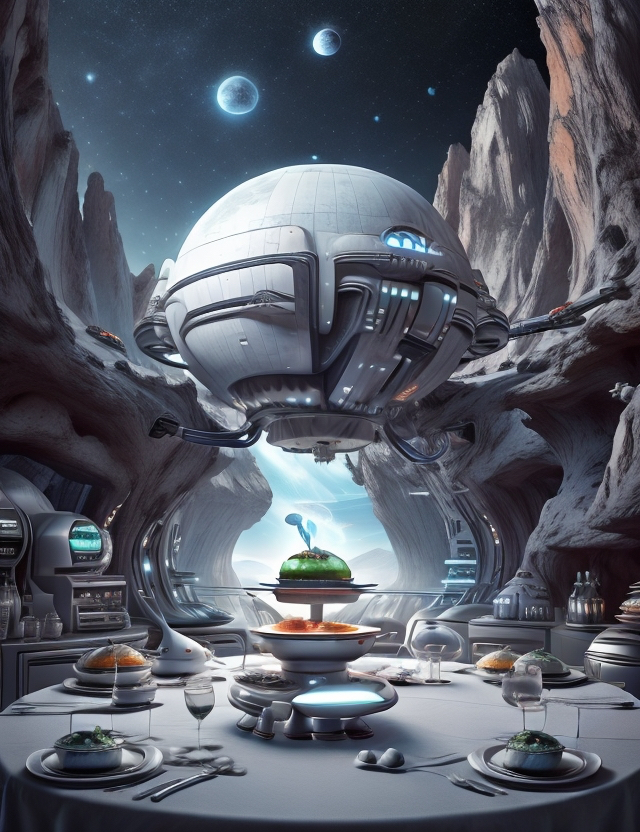
Earth’s solar system, Solis, stewarded a Way Station called Stellara. As the Cosmos Accord’s newest Way Station, Stellara was no ordinary satellite – it was a bustling megalopolis. Ironically, the Accord discovered Solis thousands of years before “The Reveal” as that first contact was later dubbed.

However, the council unanimously agreed that humankind needed to evolve before learning it was not alone in the universe. That was more an exception than the rule, as most worlds were very receptive to inheriting the advanced technologies that came with Accord membership. On the other hand, humans had a 97 percent likelihood of self-destruction. It wasn’t until 2165 that the Reveal was extended.

The first thing to catch the traveler’s eye when approaching Stellara was the imposing spaceport that extended its welcoming arms into the cosmic abyss. Spaceships of all shapes and sizes gracefully glided into the dock of this cosmic sanctuary – like birds returning to nest.

Upon disembarking, visitors entered a world that defied the traditional boundaries of Earth. Stellara’s interior was a microcosm of human culture and creativity, offering experiences for every traveler. Awe-inspiring skyscrapers punctuated the horizon, their crystalline facades shimmering with the reflection of distant stars.

For those weary from their long journey through the cosmos, Stellara boasted luxurious hotel rooms with panoramic views of the celestial landscape. The Way Station’s diverse culinary scene catered to every palate – from exotic cosmic cuisines to familiar comfort foods. Customers could dine under the simulated auroras of alien worlds or enjoy a candlelit dinner with Earth-like gravity.

Shopaholics and collectors found nirvana in the bustling marketplace spanning the satellite’s interior. Stores stocked with everything imaginable – from fashionable clothing and exotic interstellar delicacies to state-of-the-art spacecraft and exotic curiosities from the farthest reaches of the galaxy – beckoned shoppers to explore the endless aisles.

Yet, amid the commercial wonders and bustling life, Stellara was more than just a commercial hub; it is a well-lighted place of happiness and trust. People from countless worlds and civilizations converged there, bound by their shared curiosity and dreams of exploration. It was a microcosm of unity, where the universal language of discovery transcended the barriers of language and culture.

As the artificial sun within Stellara set and the stars outside appeared, visitors often said they experienced a profound sense of wonder and gratitude.

The extraordinary city in space was a testament to humanity’s boundless potential and the enduring spirit of exploration that propelled humankind further into the universe thanks to their newfound membership to the Cosmos Accord. In this age of interstellar wonder and diplomacy, the Way Stations stood as testaments to the boundless potential of collaboration among civilizations.

The Way Station’s diverse culinary scene catered to every palate – from exotic cosmic cuisines to familiar comfort foods. Customers could dine under the simulated auroras of alien worlds or enjoy a candlelit dinner with Earth-like gravity.

Ephemeris

In the small coastal town of Cresthaven, nestled between the cliffs and the sea, there stood an old lighthouse that had watched over the town for generations. Its towering presence had safely guided countless ships to the harbor, and its light had been a beacon of hope in the darkest nights. But the lighthouse had a secret passed down from keeper to keeper for as long as anyone could remember.

The secret was called the “Ephemeris,” a mysterious book that held the power to predict the future. It was said to be hidden within the lighthouse; its pages filled with the destinies of the town’s inhabitants. Many have searched for it over the years. The lighthouse seemed to guard its secret fiercely, revealing its mysteries only to those it deemed worthy.

Lena was the latest in a long line of lighthouse keepers. She had grown up in Cresthaven, hearing stories of the Ephemeris from her grandmother. As a child, she had spent countless hours exploring the lighthouse, searching for hidden passages and secret compartments. Now, as the keeper of the light, she felt a deep longing to uncover the truth behind the legend.

One stormy night, as Lena climbed the spiral staircase to the lantern room, she felt a strange pull towards the bookshelf in the corner. It was a feeling she had never experienced before, as though an invisible hand was guiding her. She reached out and touched one of the dusty old books. It shifted slightly, revealing a hidden compartment behind it.

With trembling hands, Lena pulled out a leather-bound tome. The cover was weathered and worn, and the word “Ephemeris” was embossed in faded gold letters. She couldn’t believe her luck. The legendary book was finally in her hands.

the "Ephemeris," a mysterious book that held the power to predict the future.

Lena carefully opened the Ephemeris, and its pages came to life with intricate illustrations and cryptic writings. It was as though the book had been waiting for her all along. She began to decipher its secrets, discovering that it contained predictions of the future and instructions on how to change one’s fate.

Over the following weeks, Lena used the Ephemeris to help the people of Cresthaven. She prevented accidents, mended broken relationships, and even saved lives. The townsfolk marveled at her newfound abilities and hailed her as a hero.

But as Lena delved deeper into the Ephemeris, she realized the price of tampering with fate. There were unintended consequences for every action she took to alter someone’s destiny. The balance of the town’s life was shifting, and not always for the better. The more she tried to control the future, the more chaotic it became.

One evening, as the sun set over the cliffs, Lena climbed to the top of the lighthouse. She gazed out at the sea, the very sea that the lighthouse had protected for so long. She understood now that the power of the Ephemeris was too great for any one person to wield. It belonged to the town, to the collective destiny of Cresthaven.

With a heavy heart, Lena made a difficult decision. She returned the Ephemeris to its hiding place within the lighthouse, locking it away once more. She knew that the town needed its guidance, but it could not come at the expense of free will and the natural order of things.

As the years passed, Cresthaven thrived, guided by the lighthouse’s steadfast light. Lena remained the keeper of the light, but she had learned to trust in the ebb and flow of life, understanding that some mysteries were meant to remain unsolved.

The Ephemeris, hidden away in the heart of the lighthouse, held its secrets close, waiting for the next keeper to discover its power and, perhaps, its wisdom.

The Mysterious Isle of No-Nish

Nestled in the heart of a boundless, cerulean sea lies the enchanting and mysterious island of No-Nish. This fantastical isle, shrouded in legends and whispered tales, is where the line between the ordinary and the extraordinary blurs into a world of pure wonder.

The Isle of No-Nish is a haven of lush, untouched landscapes, where emerald forests stretch as far as the eye can see, their ancient trees imbued with mystical energies that whisper secrets to those who dare to listen. The air is perfumed with the sweet scent of exotic blooms, and the sounds of melodious, unseen creatures echo through the vibrant foliage.

Wandering through No-Nish, visitors may stumble upon hidden glades where unicorns graze peacefully or discover sparkling, ethereal ponds where the water is rumored to grant wishes. The island’s shores are lined with pristine, ivory sands that sparkle like crushed diamonds beneath the golden sun, and the gentle waves beckon adventurers to explore their depths.

The Isle of No-Nish is a haven of lush, untouched landscapes, where emerald forests stretch as far as the eye can see, their ancient trees imbued with mystical energies that whisper secrets to those who dare to listen. The air is perfumed with the sweet scent of exotic blooms, and the sounds of melodious, unseen creatures echo through the vibrant foliage.

The inhabitants of No-Nish are a harmonious blend of mythical beings and ethereal creatures, living in harmony with the island’s mystical energies. Wizened wizards, merfolk, fire-dancing phoenixes, and mischievous forest spirits call this place home, adding to the island’s otherworldly charm.

Visitors who seek the island’s secrets are often drawn to the towering, crystalline spire at its center—a place of great power and ancient knowledge, guarded by enigmatic sentinels known as the Guardians of No-Nish.

But No-Nish is more than just a realm of magic and marvels; it is a place where the heart and soul find solace in the beauty of the natural world and the mysteries of the supernatural. Those fortunate enough to set foot on its shores may find themselves forever enchanted by the captivating allure of No-Nish, where the ordinary becomes extraordinary, and dreams are woven into reality.

Nestled in the heart of a boundless, cerulean sea lies the enchanting and mysterious island of No-Nish. This fantastical isle, shrouded in legends and whispered tales, is where the line between the ordinary and the extraordinary blurs into a world of pure wonder.

Elvis & the Beatles: 1965

INTRO: ELVIS PRESLEY’S LOS ANGELES HOME – AUGUST 27, 1965 – EVENING

The sun sets behind the palm trees, casting a warm, golden glow over Elvis Presley’s luxurious backyard. A long dining table is set up near the sparkling swimming pool. ELVIS PRESLEY, decked out in his signature black leather jacket and pompadour, sits at the head of the table. JOHN LENNON, PAUL MCCARTNEY, GEORGE HARRISON, and RINGO STARR, all looking dapper, sit on the opposite side. The sound of crickets fills the air.

ELVIS PRESLEY

(With a charming smile)

Well, boys, it’s great to finally have you here. You know, I’ve been a fan of yours for a long time.

JOHN LENNON

(Smiling)

And we’ve been fans of yours, Elvis. This is quite a treat for us.

PAUL MCCARTNEY

(Raising his glass)

Cheers to a night of good music and good company!

They all clink their glasses together.

GEORGE HARRISON

So, Elvis, what’s been happening in the world lately? Any news catching your attention?

ELVIS PRESLEY

(Leaning back)

Oh, you know, the world keeps turnin’. The Vietnam War is heating up, and there’s talk about civil rights everywhere. It’s a turbulent time.

RINGO STARR

(Nodding)

Aye, it’s tough out there. We’re just trying to spread some love with our music.

JOHN LENNON

Speaking of music, Elvis, we’ve got a new record coming out soon. We’re experimenting with some different sounds.

ELVIS PRESLEY

(Excited)

That’s fantastic, John! What can we expect from the Fab Four this time?

PAUL MCCARTNEY

(Grinning)

We’re trying some new stuff, you know, exploring different genres and pushing the envelope. It’s gonna be a surprise, for sure.

ELVIS PRESLEY

(Laughing)

Well, I can’t wait to give it a listen.

GEORGE HARRISON

(Changing the subject)

And what about you, Elvis? Any new movies in the works?

ELVIS PRESLEY

(Leaning forward)

Yeah, I’m working on a new film called “Paradise Hawaiian Style.” It’s gonna be a tropical adventure, lots of singing, and a few good fight scenes.

RINGO STARR

(Smirking)

Sounds like a classic Elvis movie to me!

JOHN LENNON

(Laughs)

We’ll make sure to catch it, won’t we, lads?

They all nod in agreement, enjoying their dinner and the warm California evening.

FADE OUT.

The Presley Brothers: Elvis and Jessie

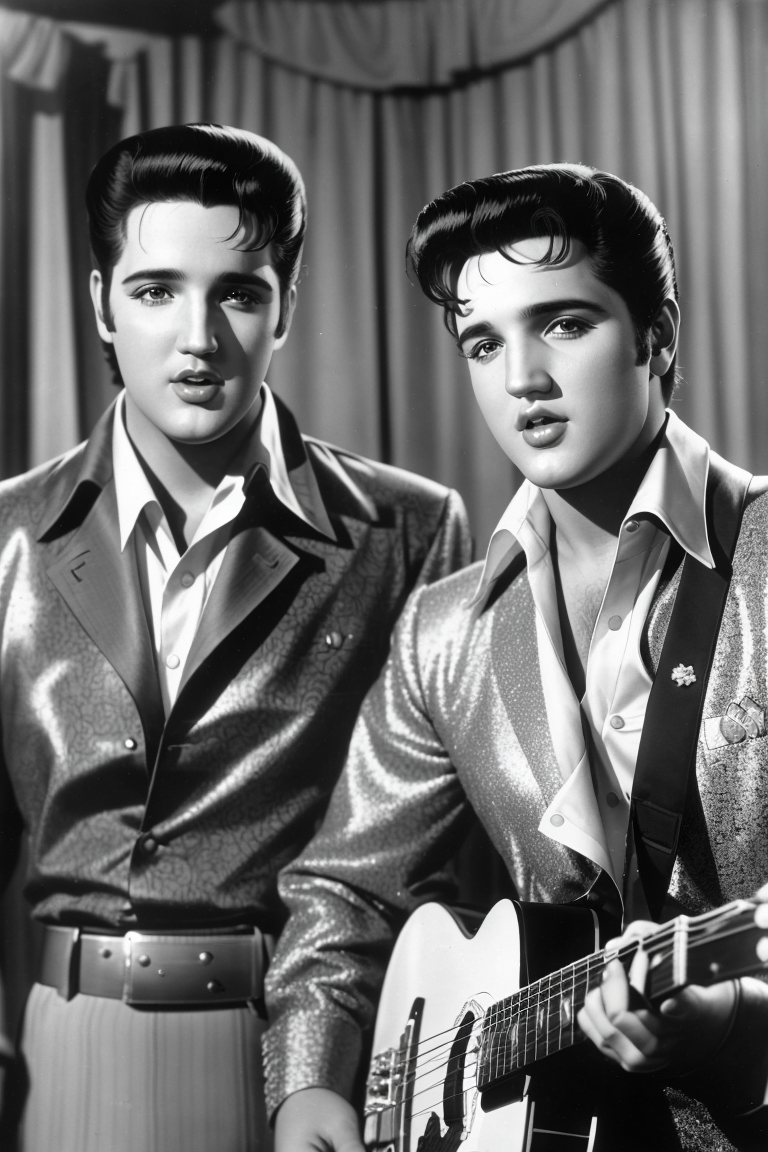
In the small town of Tupelo, Mississippi, on a chilly January morning in 1935, the Presley family welcomed not one, but two bouncing baby boys into their lives. Vernon and Gladys Presley’s joy knew no bounds as they cradled their twin sons, Elvis Aaron and Jessie Garon, in their arms. Both babies were healthy and full of life, and their laughter filled the humble two-room house.

As the years passed, Elvis and Jessie grew up as inseparable brothers and best friends. Their bond was unbreakable, forged in the shared experience of childhood adventures and mischief. They explored the lush woods surrounding their home, climbed trees, and built secret hideaways where they could retreat from the world. The town of Tupelo knew them as the inseparable duo, the two Presley brothers who were always seen side by side.

Elvis and Jessie shared not only their days but also their dreams. Their love for music blossomed early, with Elvis learning to play the guitar from his father and Jessie picking up the harmonica. Together, they would spend hours jamming on the front porch, their melodies carrying through the neighborhood like sweet Southern lullabies.

Their shared passion for music led them to form a band as teenagers, with Elvis as the charismatic lead singer and Jessie as the harmonica-playing heartthrob. They played at local venues and county fairs, wowing audiences with their raw talent and infectious energy. The girls in town couldn’t resist their charm, and the boys admired their unbreakable brotherly bond.

In 1953, as the duo graduated from Humes High School in Memphis, they faced a pivotal moment. Both dreamed of making it big in the music industry and decided to take a leap of faith together. They packed their belongings, instruments, and dreams into an old, beat-up car and set off for the vibrant music scene of Memphis.

Memphis proved to be a turning point for the Presley brothers. They hustled, performing at small clubs and bars, hoping to catch the attention of a talent scout. One fateful night, their electrifying performance at the Sun Studio caught the ear of legendary producer Sam Phillips. He recognized their potential and signed them to a record deal.

Memphis proved to be a turning point for the Presley brothers. They hustled, performing at small clubs and bars, hoping to catch the attention of a talent scout. One fateful night, their electrifying performance at the Sun Studio caught the ear of legendary producer Sam Phillips. He recognized their potential and signed them to a record deal.

With Elvis as the charismatic frontman and Jessie’s soulful harmonica, they quickly rose to stardom. Their unique blend of rock, blues, and country music revolutionized the industry. The world fell in love with their raw talent and undeniable charisma.

Elvis and Jessie remained humble and grounded throughout their meteoric rise to fame, never letting the spotlight come between them. They shared every triumph and challenge, always supporting each other through the highs and lows of their incredible journey.

As the world knows them today, Elvis and Jessie stand side by side, not just as brothers but as a dynamic duo who forever changed the face of music. Their legacy lives on in the hearts of millions, a testament to the power of brotherly love and the magic they created together.

NeoTech City’s Futuroid Emporium

In the heart of the sprawling metropolis of NeoTech City, nestled amidst towering skyscrapers and shimmering neon lights, lay a place unlike any other: the Futuroid Emporium. This was no ordinary showroom; it was a futuristic haven where the wealthiest and most influential individuals from across the globe came to shop for their very own Android Workforce.

The Emporium was a technological marvel. Its facade, constructed from self-repairing nano-glass, seemed to morph and ripple, displaying mesmerizing holographic advertisements for the latest android models. Beneath its sleek exterior, a bustling hive of activity awaited those who dared to step inside.

The Emporium was staffed by android attendants, each impeccably dressed in formal attire and programmed to cater to the customers' every need. They floated gracefully on anti-gravity platforms, their faces adorned with warm smiles, and their eyes exuding an otherworldly glow.

As visitors crossed the threshold, they were greeted by a symphony of whirring gears and soft mechanical hums. The vast showroom was divided into sections, each dedicated to a different category of Android Workforce. From nimble assembly line robots to behemoth construction machines, every task deemed too dangerous or demanding for humans was catered to.

In the corner, an elegant lady in a sharp business suit was engrossed in a conversation with a holographic sales assistant. She gestured gracefully at a line of android surgeons, each equipped with state-of-the-art medical knowledge. “I’ll take three of those for my private clinic,” she declared with a confident nod.

Elsewhere, a middle-aged industrial magnate marveled at the android welders. His factory needed a workforce that could operate in extreme temperatures without risking lives. A salesman demonstrated the androids’ precision welding capabilities, and a deal was struck with a firm handshake.

In another section, a family with a child stared in wonder at the android educators. These androids possessed the ability to adapt their teaching methods to each student’s unique learning style, making them the perfect companions for children in need of personalized education.

The Emporium was staffed by android attendants, each impeccably dressed in formal attire and programmed to cater to the customers’ every need. They floated gracefully on anti-gravity platforms, their faces adorned with warm smiles, and their eyes exuding an otherworldly glow.

But the real stars of the showroom were the androids themselves. They moved gracefully and precisely, performing tasks with impeccable efficiency. Their artificial intelligence and machine-learning capabilities had evolved to the point where they could outperform humans in nearly every aspect of labor-intensive work.

At the center of it all was a towering statue, a tribute to the inventor who had pioneered this android revolution. Dr. Victor Ingrams had dedicated his life to creating a safer and more prosperous world. The Futuroid Emporium was a testament to his vision and the relentless march of technology into the future.

As the sun dipped below the horizon, casting an orange glow through the Emporium’s expansive windows, the showroom continued to buzz with activity. The Android Workforce was poised to reshape industries and redefine what it meant to work, all under the watchful gaze of NeoTech City’s elite.

In this futuristic world, the Futuroid Emporium was more than just a showroom; it was a symbol of human ingenuity and the boundless potential of machines programmed to do tasks too dangerous for humans. The future had arrived, and it was automated, efficient, and awe-inspiring.

The Emporium was staffed by android attendants, each impeccably dressed in formal attire and programmed to cater to the customers' every need. They floated gracefully on anti-gravity platforms, their faces adorned with warm smiles, and their eyes exuding an otherworldly glow.

Red vs. Blue

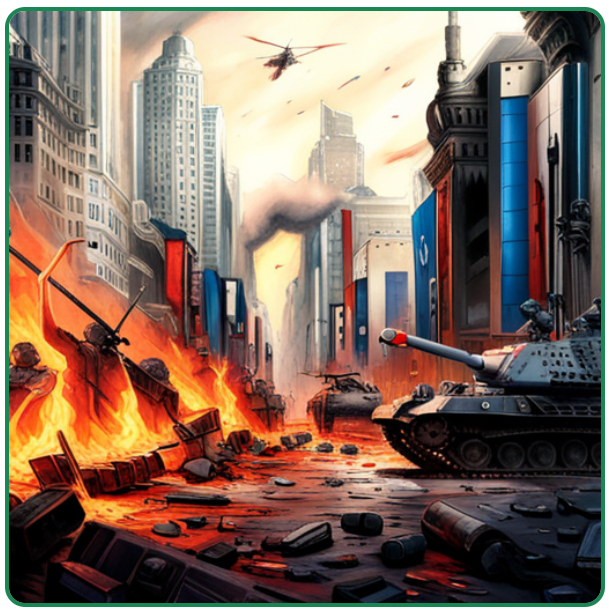
The battle raged into its twentieth day, and the once-thriving city had been reduced to a war-torn wasteland. The Blue Flag side, desperate to gain an advantage, deployed its regiment of combat androids. These metallic soldiers marched in perfect formation toward the frontlines, their mechanical limbs moving with precision and purpose.

The battle raged into its twentieth day, and the once-thriving city had been reduced to a war-torn wasteland. The Blue Flag side, desperate to gain an advantage, deployed its regiment of combat androids. These metallic soldiers marched in perfect formation toward the frontlines, their mechanical limbs moving with precision and purpose.

On the opposing side, the Red Flag forces were ready for the android onslaught. They sent their combat tanks rumbling forward, their massive turrets aimed at the approaching threat. The clash of technology and firepower was about to unfold in a spectacular and devastating display.

As the androids closed in on the Red Flag tanks, the air was filled with the deafening roar of artillery fire. Explosions erupted in brilliant bursts of orange and red, casting an eerie glow on the grim faces of the soldiers watching from the sidelines.

Amidst the chaos and destruction, the city’s skyline had become a jagged silhouette of crumbling buildings. Smoke and dust filled the air, making it hard to breathe. The once busy streets were now a nightmarish maze of debris, and the cries of the wounded echoed through the rain-soaked air.

As the androids continued their relentless advance, they faced a barrage of enemy fire. Red Flag tanks unleashed volleys of shells, sending shockwaves through the streets. Androids were torn apart, their mechanical bodies reduced to twisted wreckage. But they pressed on, relentless in their mission.

Meanwhile, the Red Flag tanks were not unscathed. Blue Flag forces had managed to damage some of them, causing explosions that sent flames and shrapnel flying. The battle had become a gruesome and relentless exchange of firepower, neither side willing to yield.

The rain fell steadily, adding to the misery of the combatants. The cold drops mingled with the sweat and blood of soldiers on both sides. The streets were now rivers of mud, and the city’s infrastructure lay in ruins.

The rain fell steadily, adding to the misery of the combatants. The cold drops mingled with the sweat and blood of soldiers on both sides. The streets were now rivers of mud, and the city's infrastructure lay in ruins.

Despite the destruction and loss of life, there were moments of heroism amid the chaos. Soldiers on both sides risked their lives to rescue wounded comrades, and medics worked tirelessly to tend to the injured. The horrors of war were etched into the faces of those who had survived this far.

As the battle raged on, it became increasingly clear that neither side would emerge victorious anytime soon. The war had taken a heavy toll on both the Blue Flag and Red Flag forces, and the city they fought for lay in ruins. It was a stark reminder of the devastating cost of conflict.

As the rain continued to fall, washing away the blood and smoke, the battle carried on into the night. The city’s once-vibrant streets were now a battleground, and the fate of its inhabitants hung in the balance. The twentieth day of the battle had come and gone, but there was no end in sight to the relentless struggle for control of the city.

Murder in Akihabara

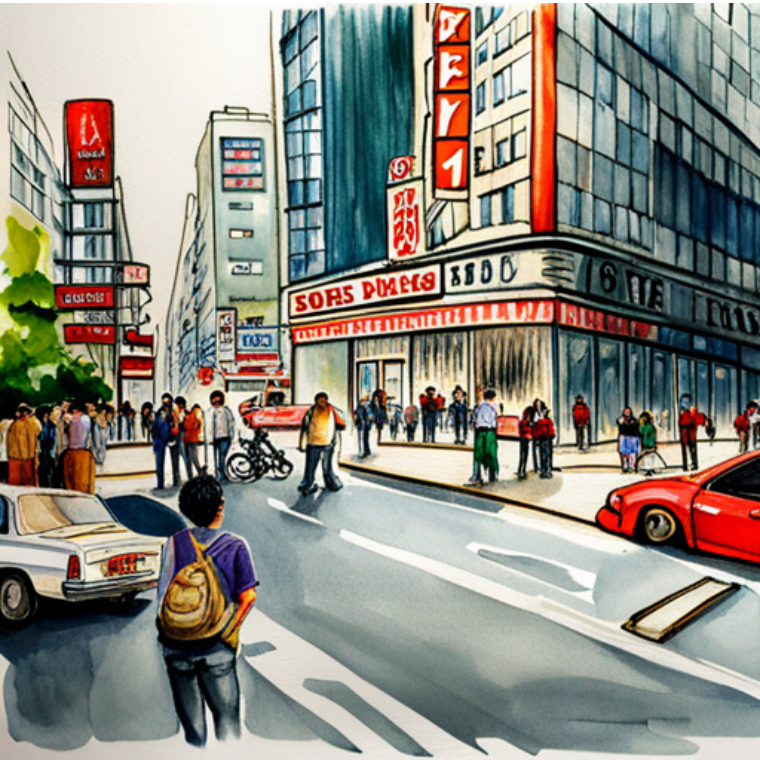
Jas Doyle had always been fascinated by Tokyo’s Akihabara district. Known as “Electric Town,” it was a kaleidoscope of neon lights and a cacophony of electronics, a sensory overload for anyone walking its streets. For a tech-savvy American journalist like Jas, it was a paradise.

Jas Doyle had always been fascinated by Tokyo's Akihabara district. Known as "Electric Town," it was a kaleidoscope of neon lights and a cacophony of electronics, a sensory overload for anyone walking its streets. For a tech-savvy American journalist like Jas, it was a paradise.

Jas was in Tokyo on an assignment for an international tech magazine, covering the latest innovations in Japanese gaming and electronics. He was right at home among the otaku, the diehard fans of anime, manga, and video games. Jas had always respected their passion for the medium, and he knew that the otaku of Akihabara were the lifeblood of the district.

One evening, as the sun dipped below the horizon, casting a purplish hue over the bustling streets, Jas found himself in the heart of Akihabara. He was chatting with a group of otaku who were explaining the intricate details of the latest virtual reality headset when the atmosphere suddenly changed. An eerie silence swept through the crowd, and the neon lights seemed to flicker in unison.

Jas’s instincts kicked in, and he turned toward the source of the commotion. At the entrance to a narrow alleyway, he saw a group of well-dressed men in black suits. Even in the dim light, their tattooed arms and menacing presence were unmistakable – members of the Yakuza.

The otaku around him began to disperse, their enthusiasm for tech overshadowed by fear. Jas knew he had to document what was happening; it was his journalistic duty. He discreetly took out his smartphone and began recording, making sure to stay behind a corner, partially hidden from view.

In the alleyway, a heated argument was unfolding between two Yakuza members. Jas strained to hear their words over the ambient noise. It became apparent that this was no ordinary dispute. It was a power struggle within the Yakuza, and tensions were running high.

Suddenly, one of the Yakuza members drew a concealed knife from his suit. Before anyone could react, he lunged at his rival with deadly precision. Blood sprayed across the narrow alley, and a collective gasp rippled through the onlookers. The victim fell to the ground, lifeless.

Jas’s heart raced as he continued to capture the grim scene on his phone. He knew he had to get the footage out to the world, but he also had to stay hidden from the dangerous men now cleaning their blades in the alley.

As the assailant turned to leave, he glanced in Jas’s direction. Panic gripped Jas as their eyes met briefly. He knew he had to act quickly. He backed away, slipped behind a stack of electronics crates, and then made a dash for the nearest exit, praying he wouldn’t be noticed.

Once back on the bustling streets of Akihabara, Jas called the police, providing them with the footage he had captured. He had a duty to the truth, and this violent assassination must be exposed. But he also knew that he had put himself in grave danger.

The following days were tense as Jas cooperated with the Japanese authorities, who were able to identify and apprehend the Yakuza member responsible for the murder. The incident sent shockwaves through Tokyo, putting Akihabara’s vibrant community on edge. But it also underscored the importance of truth and justice, even in dangerous circumstances.

Jas Doyle’s reporting made headlines worldwide, shedding light on the dark underbelly of Tokyo’s criminal underworld. He had ventured into Akihabara as a curious journalist. He emerged as a witness to a violent crime, a testament to the power of a free press and the determination to reveal the truth, no matter the risks.

The Colorado Wilderness

Journal Entry #57
April 21, 1838
The Colorado Wilderness
By Johann Diederich, Naturalist

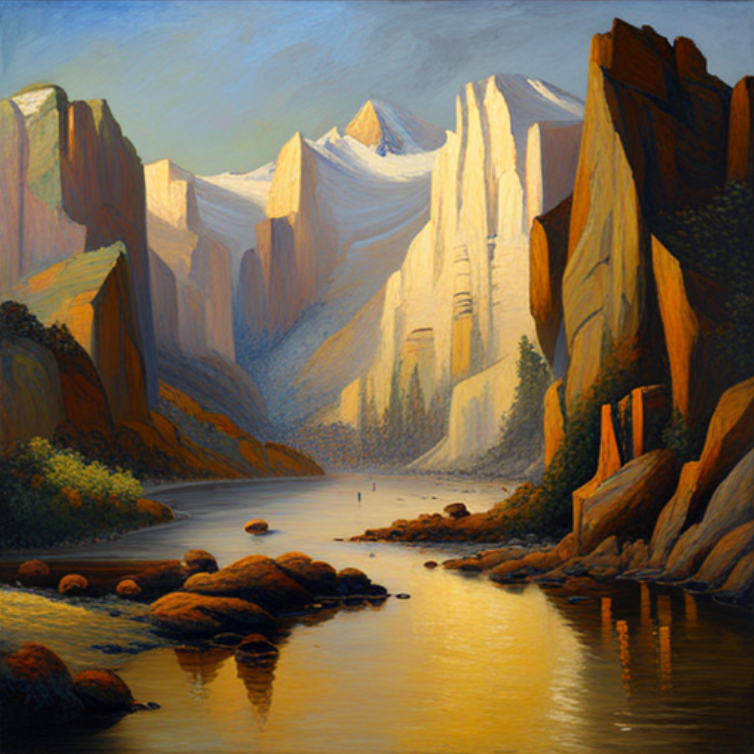
Today, I stand at the threshold of a world untouched by human hands, a hidden sanctuary of nature’s grandeur that has remained concealed for centuries. With a heart filled with awe and wonder, I put pen to paper to document the breathtaking discovery of a pristine canyon, cradling a river of unparalleled beauty.

As the first rays of dawn kissed the towering peaks that surrounded me, I embarked on an expedition more profound into the heart of the Colorado wilderness, led by an inexplicable urge to explore the uncharted. What lay before me was a world that stirred my senses and transported me to a realm of unspoiled wilderness.

The verdant forest gradually gave way to a rugged terrain marked by boulders and craggy outcrops before I stumbled upon the canyon’s edge. The sight that met my eyes was nothing short of sublime. A vast chasm, its walls sheer and towering, their shades of red and orange carved by eons of erosion, surrounded me. The river, a ribbon of crystal-clear water, meandered sinuously through the canyon’s depths, glistening like liquid sapphire under the morning sun.

The silence that enveloped this place was profound, broken only by the gentle murmur of the river as it danced over smooth pebbles and polished rocks. The air was filled with a symphony of bird calls, and the canyon walls seemed to echo their melodic tunes as if the ethereal beauty of this place enchanted the very rocks themselves.

I descended into the canyon cautiously, my heart pounding with every inch closer to the river’s edge. The water, so pristine and clear, revealed myriad aquatic life, from darting trout to the elegant, gliding form of crayfish. The riverbed, lined with moss-covered stones and delicate aquatic plants, felt like a paradise untouched by time.

Each twist and turn of the canyon revealed a new wonder. The walls bore testament to the passage of millennia, with intricate patterns etched by wind and water, their surfaces hosting a tapestry of life in the form of mosses, ferns, and even the occasional wildflower. The biodiversity here is astonishing, with a profusion of flora and fauna that I have never encountered before as a naturalist.

As the day wears on, I find myself humbled by the sheer majesty of this untouched wilderness. I am acutely aware that I stand at the intersection of discovery and preservation, and my duty as a naturalist is clear. This canyon, this sanctuary, must remain unspoiled for future generations to cherish as I have today.

I shall dedicate the coming days to meticulously documenting the flora and fauna of this pristine canyon, to ensure that its beauty and ecological significance are understood and respected. In doing so, I hope to play my part in the broader effort to conserve and protect these untouched realms of nature for all time.

With profound gratitude and an unwavering sense of purpose, I conclude this entry, eager to embrace the mysteries that this untamed wilderness continues to unveil.

– Johann Diederich, Naturalist