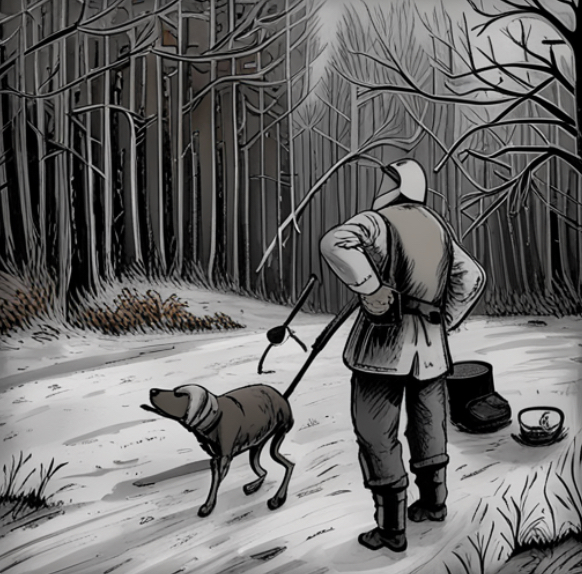
The old man opened his eyes and knew the weather was about to turn wet. His knees ached. Elwood, the hound, was snoring at the foot of the bed. The old man got up. The hunting cabin was cold.
He lit a fire and tapped coffee into the percolator. The turkey hunt would commence at sunrise.
He picked up his whiskey flask and filled it with 9 ounces of Kentucky bourbon. The copper was cold. Comforting. Elwood farted. Then the rain started. It was going to be a good day.
I wrote Sully’s Boots in 1992 as a short story. It lay forgotten on an old floppy disk for nearly 30 years until I decided to brush that old disk off and pop it into my 1998 desktop Apple computer – that still works. I cleaned it up a little and am publishing it here on my blog for the first time. Ironically, I wrote it before the internet and way before blogs.
Chapter 1
Sully Meeks had sharp, intense blue eyes framed by long, dirty-blond hair that cascaded down his narrow shoulders. His skin was nearly translucent, and when the sun cast its rays from behind, the tiny blue veins in his ears resembled a living X-ray.
Sully first stumbled upon his missing father’s Army boots on his tenth birthday while playing hide-and-seek with friends in the attic. They were nestled inside a black trunk filled with relics from his father’s overseas military service.
Known for his stubborn nature, Sully refused to yield to his peculiar predicament. From that day and throughout his teenage years, he marched on wearing those old Army boots several sizes too large.
Sully was no master of stealth. His presence was announced seconds, sometimes minutes, before his arrival. CLOMP, CLOMP, CLOMP, followed by the inevitable THUD as his wiry frame collided with the ground or furniture. Out of sympathy or superstition, the townsfolk ignored his awkward gait. Many believed the boots were cursed. “His feet stopped growing because of those boots. Take them off,” they insisted, “and his feet will catch up to the rest of him.”
As the townspeople had claimed, his feet did indeed stop growing after he first donned those boots. The doctors were baffled.
By the time he turned eighteen, thankfully, the boots no longer looked disproportionate to the rest of his body. He relied on them to stand upright, given that his tiny feet inside the boots belonged to a ten-year-old. To compensate, he stuffed the boots with socks and sought the services of the town’s cobbler, who had developed his version of Shoe Goo to keep the worn-out exterior intact. Sully became one of his best customers.
Chapter 2
Sully resided with his grandmother in Brisbane, a San Francisco suburb with a population of 3,012. Sully’s home, the largest and oldest residence in town, had been in the Meeks family for generations. The cremated remains of Meeks family members (and their beloved pets) were housed in urns scattered throughout the house. Every cabinet, bookshelf and table held these urns, creating an in-house crypt.
The tradition began with Sully’s great-great-great-grandfather, Peter Joseph Meeks, who adamantly declared while suffering from stomach cancer: “I don’t want to be stuck in the cold, wet ground where maggots and worms can get at me. Keep me right here at home, warm and comfortable.”
Three months later, his cremated remains were placed in a brass urn atop the kitchen China cabinet where it remains today. Peter Joseph, ever the planner with a dry sense of humor, had inscribed:
When Mary, Peter Joseph’s wife, passed away three years later (she fell into the backyard well), her urn joined her husband’s on the China cabinet’s top shelf. In the years that followed, urns gradually replaced all of the storied China, and then they began encroaching on the bookshelves until every available space was occupied.
Each urn had an inscription and a personal “memento” chosen by the person it housed, from lockets of hair to photographs, rings, small trinkets, and even a set of false teeth. Peter Joseph’s trusty Hamilton conductor’s pocket watch rested inside a small glass case atop his urn.
Chapter 3
Sully’s life was filled with sorrow. A drunk driver tragically killed his mother while holding his hand crossing a San Francisco street when he was just seven. His father, a U.S. Army private, went missing during a training mission in Germany earlier that year.
On rainy days, Sully sought solace by visiting his mother’s urn in the living room, accompanied by her “good luck” charm, an 1858 silver dollar her father gave her on her sixteenth birthday. His father’s empty urn and well-worn catcher’s mitt were situated next to it on the fireplace mantle.
Chapter 4
Shortly after his nineteenth birthday, Sully’s grandmother suffered a mild stroke and spent much of her time sitting with her son’s baseball glove and staring blankly out the front window. One day, he thought she had passed away in the living room chair. She was sleeping, but it was quite a scare. He decided then that it was time to bring his father home.
With passport in hand, Sully embarked on a journey to Heidelberg, Germany, where his father had been last stationed. Recognizing the likelihood of a lengthy mission, he secured an under-the-table job from a local pension owner to make ends meet.
Sully quickly forged a friendship with Edith, a female information officer at the U.S. Army base. She accessed his father’s file and discovered that he had been on a flight-training mission when his plane crashed in a heavily wooded Rhineland-Pfalz region, an hour’s drive from the base.
Hiking over rugged terrain in his oversized boots proved challenging, and Sully fell more frequently than usual. However, an adventurous soul, Edith joined him every weekend in scouring the countryside for his father’s missing plane. She laughed as she extended her hand to help him up, oblivious to the mystery of his tiny feet.
Chapter 5
On her seventy-ninth birthday, two weeks before Christmas, Sully’s grandmother received a large box from Germany. A note from Sully sat atop the package. Like all his correspondence, it was concise:
“Hi Grandma. Here’s your Christmas present—I think you’ll like this one. Don’t wait until the 25th; open it now! Also, I am sending my ‘memento.’ I will send my urn later. I saw some neat ones here in town. I met this nice American girl at the Army base. I’m going to stick around and see how things go. More later.
Love, Sully”
Tears welled in her eyes as she set the note aside and unwrapped the package. Inside, she found a clear plastic container holding what looked like sand. On closer inspection, she realized it held human remains—Sully’s father, finally home.
Overjoyed, Sully’s grandmother placed her hands over her heart and exclaimed, “Thank you, dear Jesus! Oh, thank you, my dear Sully!”
Inside the box, there was a second, heavier object. She removed the forgotten issues of the newspaper packing, and there they were – her son’s — and most recently Sully’s — battered Army boots, bronzed. She placed them on the mantle next to her son’s urn, where they belonged.
A few months later, back in Germany, Sully noticed that his “size two” shoes were getting tight. Within a year, Sully, now twenty-one, proudly wore a very respectable size eight.


 The Diederich Journal