
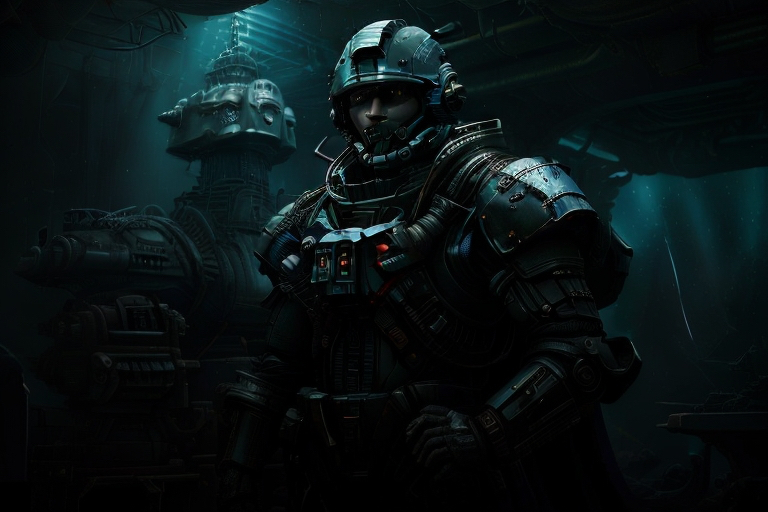
September 29, 2275: Captain Jonathan Steele stood in the dimly lit hangar bay of the USS Quantum, a vessel unlike any other in the history of human exploration. His life-support suit clung to his body, its sleek black surface shimmering with protective nanites. The helmet he held under his arm displayed an array of complex readouts, all linked to the ship’s quantum computer.
The USS Quantum was a marvel of human ingenuity, designed to traverse the uncharted territories of the Quantumverse. Humanity had long since conquered the cosmos, but the Quantumverse remained a realm of mystery and untapped potential. Here, the laws of physics operated in ways that defied conventional understanding.
One of the most enigmatic phenomena of the Quantumverse was quantum tunneling. In this reality, it wasn’t a rare occurrence in the familiar universe; it was the foundation of transportation. By manipulating quantum mechanics, objects could be translated instantaneously from one location to another. It was like space was a fluid medium through which they could flow.
The Quantumverse was an eerie realm, a place of four-dimensional oddities that challenged the limits of human comprehension. Objects existed with an extra spatial dimension, and Captain Steele knew they couldn’t be fully visualized in three-dimensional terms. Instead, various projections were used to represent these mysterious 4D entities.
One such entity was the tesseract, a four-dimensional cube. When rotated and viewed in three dimensions, it appeared as if various cubes were moving in and out of the tesseract, a mesmerizing dance of geometry that was as beautiful as it was baffling.
But the most intriguing and perilous feature of the Quantumverse was the existence of white holes. They were the inverse of the dreaded black holes that had long fascinated and terrified humanity. Instead of objects being sucked into a singularity, white holes ejected objects from their enigmatic depths.
However, what made white holes in the Quantumverse truly unique was their ever-changing forms, depending on the quantum rule region in which they were located. These regions were like pockets of distinct reality within the Quantumverse, each governed by its own quantum laws. In one region, a white hole might appear as a swirling vortex of prismatic light, while in another, it could resemble a vast, crystalline structure.
Captain Steele had been preparing for this moment for years, studying the research of countless quantum physicists and collaborating with engineers who had pushed the boundaries of technology. He had been selected to lead the maiden flight into the Quantumverse. This journey held the promise of untold discoveries and the potential to reshape humanity’s understanding of the cosmos.
His heart raced with anticipation as he stepped onto the USS Quantum’s boarding ramp. The ship’s quantum engines hummed to life and a soft blue glow enveloped the craft. The moment had arrived, and Captain Steele couldn’t help but feel a sense of awe and trepidation as the USS Quantum prepared to breach the boundaries of known reality.
With a final, resolute nod, he donned his helmet, securing it in place. The moment the helmet sealed, he spoke the words that would initiate the journey of a lifetime, “Initiate quantum drive.”
And with that, the USS Quantum vanished into the Quantumverse, leaving behind the familiar confines of space and time – venturing into the uncharted territory of four-dimensional wonders and ever-changing white holes. Captain Jonathan Steele was an intrepid explorer, boldly venturing where no one had gone before, and the mysteries of the Quantumverse awaited his discovery.
 The Diederich Journal